March 20, 2013
Just some random, not really related, musings on the nature of time.
Somber mood here folks.
———————————–
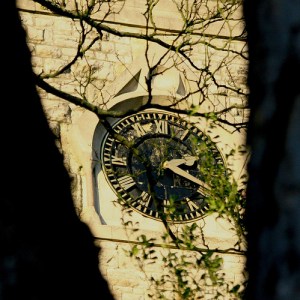
A clock is a collection of gears and movable pieces. One gear causes another to turn, which in turn causes another to turn, ultimately a hand on the clock face moves forward a tick. It is in no way connected to the dimension of time. A clock moving backward does not reverse time, a broken clock does not stop time. The gears may move the clocks’ hands, or the gears may move a hand mixer. Neither perceives time. Perception of time is a unique characteristic of higher level living things. Biological clocks work with the decay and growth of certain enzymes, cellular growth, the presence or absence of certain biochemical markers. None of that perceives time. Humans may be unique in being aware of the motion of time.

A man takes a summer stroll through a wood.
He has never been there, has no destination in mind, he has all day at his leisure to enjoy nature.
As he walks along a well-worn path he enjoys the scent of the air, fresh grass, and slight dew.
The sun is high but not hot, the man is filled with the oneness of being.
The path moves among hills and across small, stone-filled rivers.
It gently curves, first to the right, then slightly to the left, but ultimately it wends its way forward.
After a bit of a gentle downward slope, the path branches into two directions.
Each path offers equal beauty. Neither path has more to recommend it than its brother.
It would be good, thought the man, to walk one path and see where it leads. Then, if I care not for the destination, return and walk the other path.
As far as he could perceive, neither path looped back upon itself. It seemed that once setting foot upon a branch that would be the path taken. For it seemed silly to walk the path to the end only to walk it all the way back and take the other path. And what would be the guarantee that the second path would be more pleasing than the first?
The man set his foot and began to walk. What else could he do?
An otherwise poor film contained the line time is the fire in which we burn. Some live their lives like a burning star, only to die before their time. Others only sputter, most smolder and crackle with the occasional flare, until they too die.
Time is the fire in which we burn artistically, if perhaps simply, points out a universal truth: everyone dies. Or perhaps to stay in the realm of the pure and scientific, entropy increases. It is a law of thermodynamics.
A man builds a small house in a remote country. Answering an urgent summons, he leaves, never to return, the house never occupied. Alongside the house is a large pile of bricks and stones that the man had intended for a small garden shed.
Over time the house and bricks remain undisturbed in the remote country. Still they remain, over years, decades, scores, untouched.
A century, perhaps, later, they have come to resemble each other, the house and the pile of bricks. Yet the bricks and stones have not risen into a shed.
And in truth even the pile of bricks and stones has not fared well. Over the long years the edges of the bricks have crumbled. Some have fallen off the pile and split apart. Some of the stones have begun to wear smooth, the eon-long process of erosion.
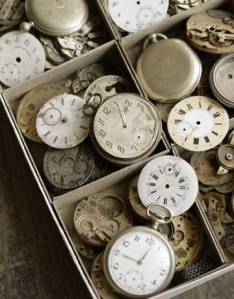
“Fine wine improves with age,” sayeth the truism. Perhaps, but the taste is due to a chemical reaction, in a broad sense, of decay, of chains of molecules breaking apart.
“Youthfulness” is simply a euphemism for not acting your age.
“Second childhood” is senility.
And life is too short.
If you like what you see, please share this:
Tags: bmj2k, clock, Mr. Blog, Mr. Blog's Tepid Ride, Mr. BTR, musings, philosophy, random, star trek, TIME, Travel




 Mr. Blog's Tepid Ride
Your Comments