September 5, 2011
I just finished a Dark Shadows marathon. I watched 1,225 episodes, two original cast movies, and the 12 episode 90’s revival in just about a year and a half. On top of that I also listened to four modern Dark Shadows audio dramas and read both a series guide and six novels published as the show ran in the late 1960’s. Throw in the collection of comics by Gold Key and it is fair to say that yes, I know a little bit about Dark Shadows.
For those not in the know, Dark Shadows is a soap opera that ran from 1966 to 1971 on ABC. Unlike nearly every other daytime drama of the time, every episode exists, minus one, but that episode’s soundtrack survives so it is the most complete- by far- show of its type. Compare that to Doctor Who whose shows of that era have almost as many lost as there are still in existence.
The show was a dark and spooky half-hour drama (done on a tiny budget) that regularly featured ghosts, werewolves, time travel, witches, spiritual possession, mad scientists, Frankenstein-like creatures, parallel worlds, immortal Phoenixes, and vampires. And if you know the show there is one name that leapt to mind as soon as you saw “vampires,” Barnabas Collins. 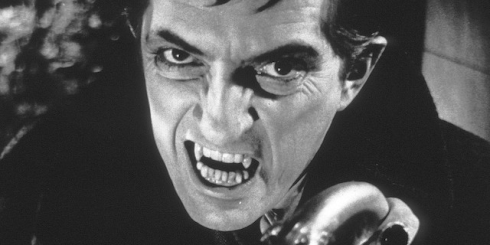
And he was not just any vampire. Dark Shadows is widely credited with the creation of the modern conflicted vampire. Barnabas Collins was turned into a vampire by a witch’s curse, and instead of destroying him, his father chained him in a coffin. 200 years later he was freed and met a doctor, Julia Hoffman, who cured him. Barnabas would revert back to vampirism a few times over the course of the series, but he was usually a tragic figure, hating what he had become, longing to be human again, and generally becoming the romantic hero of Dark Shadows.
And that is why I hate him.
Until Barnabas vampires were universally characterized as evil. Though Bram Stoker’s Dracula defined the modern vampire, with some help from a few Gothic forebears, the contemporary Twilight vampire and others of that immature ilk all descend from Barnabas Collins.
Take the classic vampire. To be concise I’ll skip the ancient creatures of mythology and proto-religion and move to the 18th Century.
The OED dates the first appearance of the word vampire in English from 1734, in a travelogue titled Travels of Three English Gentlemen. However, the word itself has roots going back to Eastern Europe as early as the 11th Century.
Vampires were usually reported as bloated in appearance, and ruddy, purplish, or dark in color; these characteristics were often attributed to the recent drinking of blood. Indeed, blood was often seen seeping from the mouth and nose when one was seen in its shroud or coffin, and vampires of the Balkans and Eastern Europe had a wide range of appearance ranging from nearly human to bloated rotting corpses.
None of them sparkled.
Gothic writers like Sheridan Le Fanu added beauty and sexuality, and Bram Stoker added class and refinement, but one thing remained constant: The vampire was a creature of unrepentant evil. And more importantly, he was always an animated corpse. Vampires are classically feared as revenants of evil beings, suicide victims, or witches, but they can also be created by a malevolent spirit possessing a corpse or by being bitten by a vampire. Vampires are distinctly creatures of the supernatural or demonic realm.
Dark Shadows was also one of the early (though not the first, Richard Matheson explored this theme too) depictions of vampires being cured through scientific methods, which is totally at odds with the “black magic” or demonic origins of the vampire. It was never really clear, nor did it really make sense, how a series of blood transfusions cured Barnabas Collins’ witch’s curse.
Teenage fiction is full of nobly conflicted vampires, utterly handsome, all needing the love of that one girl to turn him around. They are the rebellious bad boys who really aren’t that bad at all, deep down. Dark both in personality and looks (despite somehow also being pale) and brooding, they are the property now of the teen and adolescent.
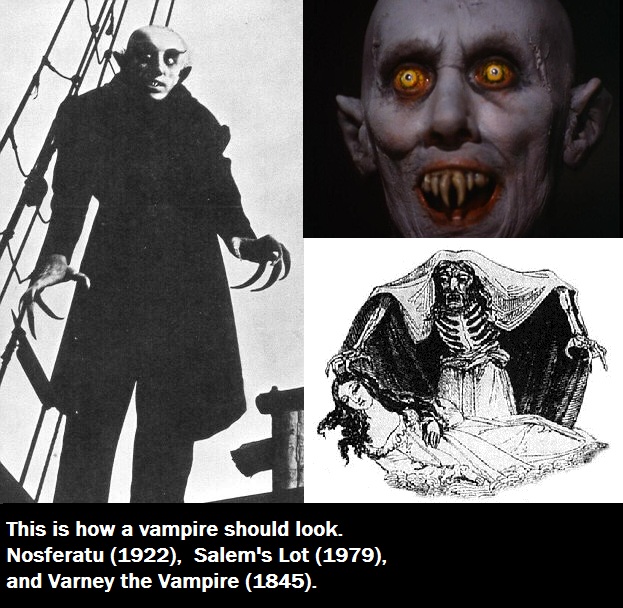
And that is a damn shame because the vampire should be the boogey man in your closet who comes out not to whisk you into a fantasy world of delight but to rip your throat open and gorge himself on your blood as it sprays gristly crimson ichor across his face. And that face shouldn’t inspire love or lust, the vampire’s face should inspire extreme fear, panic, and revulsion, but most of all, it should be the last thing you see before you pass out or die.
Vampires are not handsome. They are repulsive and loathsome creatures whose breath reeks of the grave. They have moldy dirt under their fingernails from crawling out of the earth and their skin is more than pale and pasty, it is almost translucent, stretched over their body too tightly and their teeth seem long only because their gums have receded and withered. They are animated corpses.
Vampires are not charismatic. They are cunning like animals, like wolves. They do not throw elegant dinner parties. Like rats, a vampire may crawl on the ground through the mud to bite your ankle and in centuries past anyone asleep in a field kept his shoes on at night lest a vampire suck the blood out of their heels. No romantic embraces for them, for a vampire is past the point of love or romance. They are malevolent killers.

One of the great ironies of Dracula, and one of the great bits of Stoker’s writing (of which I otherwise have many faults) is that Count Dracula arrived in England on a ship called the Demeter. Demeter was the Greek goddess of the harvest, a life-bringer. Dracula brings only death.
I loved every minute of Dark Shadows, even the early episodes where there was little supernatural and the drama revolved around the threat to the Collins family shipyards. And I loved Barnabas Collins, even if he did single-handedly ruin the vampire genre for decades to come.
If you like what you see, please share this:
Tags: ABC, Balkans, Barnabas Collins, bmj2k, Bram Stoker, Dark Shadows, Dracula, Eastern Europe, horror, Julia Hoffman, Mr. Blog, Mr. Blog's Tepid Ride, Mr. BTR, mythology, Nosferatu, Richard Matheson, Salem's Lot, Sheridan Le Fanu, soap opera, supernatural, Travels of Three English Gentlemen, Twilight, vampires, Varney the Vampire




 Mr. Blog's Tepid Ride

Your Comments