March 25, 2011
 In the annals of parapsychology, no creature has a greater basis in fact that the mummy. They do exist. Mummies have been discovered in nearly every part of the world, dating back untold centuries. They are on display in museums across the globe.
The most well-known, the Egyptian mummy, is the result of a complicated process. After death, the body was treated with certain chemicals designed to preserve it long after death, and wrapped in special bandages also soaked in chemicals to aid in preservation. The body itself is adorned with all the elaborate trappings of life. Pharaohs of ancient Egypt were interred in pyramids, huge testaments to their importance and the gateways to their new world, the afterlife.
Buried with the Pharaohs were gold, jewels, and more mundane items, all of which were their for their later use in the world after death. Most of the grand tombs of the ancients have long been found to be empty, looted by grave robbers willing to risk the curses associated with the tombs for the fabulous wealth within.
The most famous Egyptian tomb was discovered by Howard Carter in 1922. It was the most complete, fabulous tomb of the young Pharaoh King Tutankhamen who ruled from BC 1333 to 1324. Along with the jewels and treasure, Howard Carter also discovered sealed jars. When opened, they were found to contain the remains of King Tut’s organs. Mummies had them removed and carefully preserved to delay or avoid decomposition.
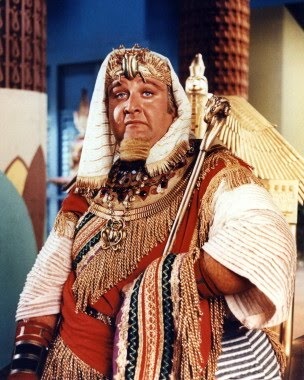
Much is known about King Tut. Renowned as the “fun pharaoh,” he ruled over a kingdom famed for song and merriment. In fact, a song performed by King Tut himself, “King Tut,” went to number two on the Egyptian charts, kept out of the number one slot by “Nile Delta Blues” by Pinetop Per-Kin-Ra.
 The song was later covered by Lady Gaga-Ra in BC 1218.
The cause of Tut’s death is unknown, but it is speculated that he was assassinated by political enemies. What is known is that after his removal from his tomb in 1922, the mummy of King Tut was reanimated when a an assistant archeologist read from the scroll of Toth. Far from being the fun-loving King Tut, the reanimated pharaoh returned to life angered at those who betrayed him.
Parapsychologists have long hunted The Mummy. Sightings have them as far afield as Scotland, where he was allegedly photographed near Loch Ness in what has become known as the Surgeon’s Mummy Photograph. Yes, Loch Ness. It was a coincidence.
 The creature is driven by rage. Researchers feel that The Mummy is a threat to all of humanity. Many amateur groups have tried to stop him but not even the most seasoned of meddling kids have been able to end his threat.
 The Mummy is known to be devious and clever, and uses black magic spells and incantations. He has been kept alive by drinking the juice of nine tana leaves, a species indigenous only in the mythical realm of Thundera. It is there that he is often thwarted by a group of parapsychologists calling themselves Tundercats.
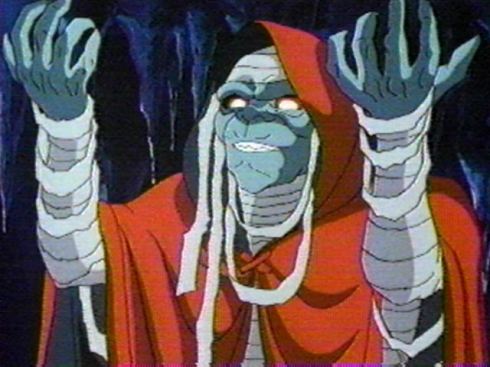 Many people scoff at the mummy. They put him in the same category as the Jersey Devil and the New York Mets. Proponents point to the lack of empirical evidence. They say that magic does not exist. They contend that Thundercats is a cartoon and Mumm-Ra and Tut are clearly not the same character. Despite a keynote address by Ardath Bey, noted Egyptian expert and producer of 1932’s documentary The Mummy, skepticism remains.
The motivations of The Mummy of King Tut are not always clear. Although classical Egyptologists are divided on his motivations, most hold that he has a specific set of goals. 1- To avenge his death. 2- To find the reincarnation of his lost love and claim her for all eternity. 3- Win the Indianapolis 500.
Other aspects of his personality are also well-documented. Despite his love of his native Egypt, King Tut is also fiercely loyal and patriotic to his adopted land. In 1939 he became a naturalized American citizen under an assumed name, Kharis von Imhotep of Sweden. When World War Two broke out he enlisted in the US Army.
 A series of comic books detailed his exploits and made him a modern-day folk hero. However, he returned home only to find himself once again hunted by scientists and monster hunters. Bitter and rejected he turned once again to a life of evil, rededicating himself to destroying humanity.
Parapsychological research groups continue to monitor the world for signs that he has surfaced. Credible reports are often hard to come by. One of the last confirmed sightings came in 1967.
To finance his arcane rituals he turned to a life of crime. The arch-fiend was last spotted in Gotham City.
 The violence in the Middle East and the uncertainty in Egypt have given new fears that The Mummy may be behind the chaos.
The menace of The Mummy cannot be overstated. If you spot The Mummy there are certain steps to take. First, make sure you are not looking at an accident victim. The Mummy is often mistaken for victims of car accidents. Next, do not, under any means, ask him for The Mummy’s autograph, and lastly, never stare at his Ankh.

If you like what you see, please share this:
Tags: archeology, Ardath Bey, Batman, bmj2k, Boris Karloff, Egypt, Egyptology, horror movies, Howard Carter, Imhotep, In Search of, Johnny Quest, Kharis, King Tut, Loch Ness, monster movies, monsters, Mr. Blog, Mr. Blog's Tepid Ride, Mr. BTR, Mumm-Ra, old movies, Scooby Doo, SNL, Steve Martin, The Mummy, The Unknown Soldier, Thundercats, Victor Buono, World War Two










 Mr. Blog's Tepid Ride
Your Comments