
September 19, 2011
Today’s post is a tantalizing tale of imponderable probability and vague veracity. Settle in for The Mad Nazi and the Invisible Bridge of Mid-Town Manhattan.
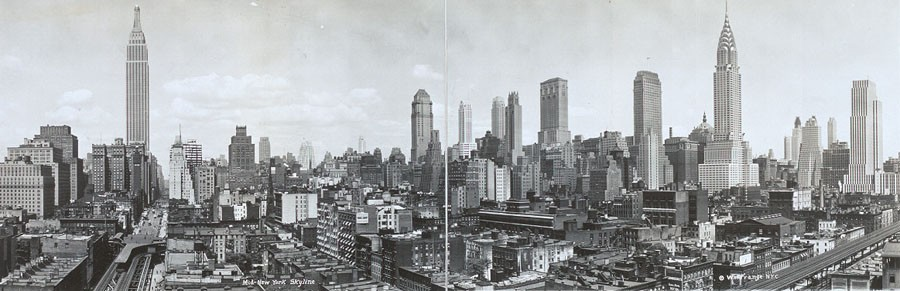
During the post-war building boom the New York skyline reached for the stars. Great towers of steel and glass soared as city real estate became scarce. Land barons and moguls found themselves boxed in shoulder to shoulder with their neighbors in the crowded city, unable to expand their holdings. But even if they could not expand horizontally, they could still reach for the sky. The height of their buildings was limited only by manpower, materials, and imagination.
Imagination was never in short supply, and manpower was delivered by thousands of returning GI’s. One of the side-benefits of the war effort was that new materials and technology developed for the military was becoming available for civilian use. And some should never have fallen into civilian hands.
In the last days of World War II, a fiendishly brilliant but utterly mad Nazi scientist toiled in Hitler’s laboratories to create a method of making German warplanes undetectable to Allied eyes. He planned to build a new generation of war machines out of an invisible metal he was on the verge of creating. And if planes could be made invisible, so then could tanks, battleships, and ultimately even soldiers.
 It was in the final stages of testing when an allied air strike destroyed the laboratory, burying the last hopes of Hitler just scant days before the planes were to go into production, and the deranged scientist himself died in the blast.
Not long after, American troops arrived and occupied the area. In a pouring rain, a lone soldier took refuge in the ruins of an old building. The soldier, a private returning from a patrol, took as much shelter as the half-collapsed building could provide, moving far back into the structure. Poking through overturned cabinets and kicking piles of ashes and half-burnt papers, his eye caught a single page, nearly uncharred, and covered with what seemed to be diagrams and blueprints for a strange new airplane. Although he couldn’t read German, he judged by the angry red words stamped across the top that he had found something important. He carefully folded it and stored it in his pack, and when the weather allowed he returned to camp, where the strange document passed from private to lieutenant to colonel, up the chain of command to general, and ultimately to a small and secret government research lab in Washington DC.
The formula the scientists interpreted was beyond even the intellect of the top US research scientists. Try as they might, none of them could create the “invisible metal” of the brilliant but insane Nazi. Out of desperation, the top army generals turned to the one man capable of synthesizing the complex chemical compound. He was a young genius, a whiz kid of science, whose New York chemical company was the centerpiece of scientific advancement. He had led his company in creating many innovations for the government during the war, and his rapidly growing Manhattan offices now occupied most of the floors of two gleaming skyscrapers that stood directly across from each other on either side of a busy mid-town avenue.
 The brilliant chemist was not only able to follow the mad Nazi’s work, he continued it, creating dozens of invisible metal prototypes, many of which graced the offices of powerful congressmen and senators. And not only was they invisible, but any metal infused with the compound became extremely strong and flexible.
The first practical demonstration of the invisible wonder metal was to be a bridge connecting the two office towers, spanning the busy metropolitan street below. No longer would the scientist have to dodge crowds and taxis while going from one department to another, the invisible walkway would make his company whole, allowing him to stride on the sunlight 20 stories above the traffic.
Being a military project, the bridge was built in secret, at night, and it took far shorter than expected because the metal was so easy to work with. In a matter of mere days the span was completed and top ranking officials flew in to New York to witness the unveiling.
All was ready, final tests had been completed, and just hours before the bridge was to open, a junior laboratory assistant rushed into the company’s head office and, with a force that dented the desktop, smacked the final test results down on the head scientist’s desk. A terrible discovery had been made.
Prolonged exposure to direct sunlight made the metal react with oxygen, turning it weak and brittle, though still maintaining invisibility,
It was a devastating blow. The government cancelled their contracts, and all the money that was poured into the invisible metal project was never recouped. The company was ruined, and no one ever crossed the invisible bridge in the sky. It was classified a military secret and all documents pertaining to it were confiscated.
The chemical company sold one skyscraper, then the other, and though it limped along for a few more years they eventually went bankrupt and the amazing wonder kid of the scientific world killed himself by jumping off the Brooklyn Bridge.
The buildings went through a succession of owners and tenant after tenant took over the chemical offices. None of them knew that just below a certain window lay an invisible walkway, and the bridge, whose existence was known only to a very few to begin with, was forgotten and lost to memory.
The only records of it can be found in certain old and dusty documents filed in the bowels of the National Archives, and for six decades the bridge has been high in the sky, like an invisible Sword of Damocles, hanging above the heads of the unknowing throngs below.
The few in government who have been around long enough to remember the bridge refuse to discuss it. If pushed, they will tell you it is only a myth. After all, would you tell the people of Manhattan that a brittle and nearly collapsing invisible bridge twenty stories in the air might come crashing down at any time as they crossed a certain busy street in mid-town Manhattan?
This New York Legend comes to you courtesy of a New York radio legend, overnight icon and late-night radio pioneer, Long John Nebel, with flourishes and embellishment by yours truly.
Cue mysterious laughter.
An audio version of this legend first appeared just last week in the amazing FlashPulp website. Check them out for awesomeness and goodies!


 Mr. Blog's Tepid Ride
Your Comments