
June 28, 2011

Primum non nocere is Latin for “first, do no harm.”
Nonmaleficence, which derives from the maxim, is one of the principal precepts of medical ethics that all medical students are taught in medical school and is a fundamental principle for emergency medical services around the world. Another way to state it is that “given an existing problem, it may be better not to do something, or even to do nothing, than to risk causing more harm than good.” It reminds the physician and other health care providers that they must consider the possible harm that any intervention might do. It is invoked when debating the use of an intervention that carries an obvious risk of harm but a less certain chance of benefit.
With that lofty sentiment in mind, let us turn to the world of medicine with the intention of celebrating the true milestones of that noble profession, and the eminent men and women who day in and day out live by the precept of “first, do no harm.”
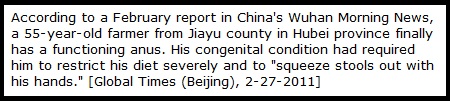
Is there any more noble calling than to give a man the miracle of a functioning anus? One can certainly imagine the horrible suffering in his daily life that the unidentified man had to go through, to “squeeze stools out with his hands.” If I were that man, I would certainly like to be unidentified too. For this we salute you, oh practitioner of the surgical arts. I am sure you never expected anything like this when you went to medical school.
If it is true that those also serve who stand and wait, it is certainly true that those also serve who stand behind the clipboards and wait for the tests to get back from the lab. I am referring to the medical researchers, those men and women, the modern-day Pierre and Marie Curies, without whom no advances in medicine would ever be made.

Also known as the “Innie/Outie Inquiry,” the Belly Button Biodiversity Project has added volumes to the literature devoted to the human navel. It is hoped that one day it will actually be read. One can only imagine the millions of Federal tax dollars that went into the common-sense discovery that an old man’s belly button is different than a young girl’s. We may scoff, we may adopt an attitude of aloof superiority or at best, indifference, but still we must also acknowledge and applaud the supreme effort, persistence, and sheer creativity that went into getting that grant approved.
However, some heroes go unrecognized. For many, the act of helping their fellow man is the only reward for which they strive. Truly, it is the anonymous man who performs CPR to an accident victim or the battlefield nurse who performs first aid under fire who deserve our acclaim and our respect. These are but two of the unsung heroes of whom I speak.

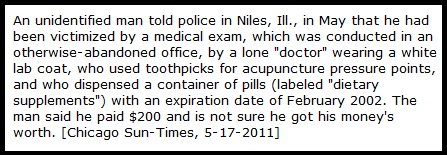
We may never know the identity of these Angels of Mercy, but be sure that their victims, sorry, patients, will forever have a place for them in their hearts. For these enema enthusiasts and dietary pill pushers, glory, fame, and police attention are the last things they crave. Wealth and fame they’ve ignored. Helping their fellow man in the privacy of an abandoned office away from prying eyes is their reward.
It is our hope that these Medical Milestones will one day find their proper due in the annals and journals of their professional colleagues, for “first, do no harm” comes second only to “pay at the desk on your way out.”


 Mr. Blog's Tepid Ride
Your Comments