
January 18, 2011

Ever wonder what Jurassic Park would be like without the dinosaurs? Wonder no more as FOX presents Terra Nova, the gripping semi-drama of an extended camping trip on prehistoric almost-Earth.
The show opens in the year 2149. The air is polluted, huge multinationals have created mega-cities, and there is a strict policy of two children per family. OH, sorry, that’s 2012 Asia. Anyway, the premise of the show is that the Shannon family managed to escape into the past and start anew on prehistoric Earth. Good thing too, because as any sci-fi fan knows, the Daleks are due to invade the Earth in 2150 so they got out just in the nick of time.
It seems that in the future a Stargate- SORRY, I mean portal- has been found allowing folks to enter the time tunnel and- SORRY, I mean portal- and quantum leap- SORRY, I mean time travel- back to Jurassic Park-SORRY, I mean Earth’s Cretaceous Period- and start civilization all over again.
You may have noticed in your reading of the preceding two paragraphs that Terra Nova is long on unoriginality.
You may also be thinking that colonizing prehistoric Earth is a very bad idea with horrible repercussions for the future. Imagine all the huge changes their very presence back there would create, all the alterations of the time stream, all the screwing up of the future that every passing second multiplies. You may imagine all that but don’t bother. The deus ex machina is that the portal sends everyone to an alternate Earth. Yes, an alternate prehistoric Earth. So not only are they in the past, they are in an alternate reality, so if the creators of the show want to ignore the fact that the concentration of oxygen was different back then, and Earth’s slightly different gravity and magnetic field would create problems for people and machines alike, well, they can. And they do. Things are pretty much the same back there. I expect to see a Boy Scout troop blundering in at any time.
Terra Nova is a large colony that operates like a hippie commune with armed guards and a policy of not doing much of anything. It is pretty much like camping out. Since the portal only goes one way (at least for now) they are essentially on their own. (Except when the show decides they are not.) There also doesn’t seem to be much colonization going on. In fact, the main thing the colony does is fret about a rival group of people from the future. They’ve locked themselves in a compound in order to fend off attacks from the bad guys. Same as Falling Skies. Same as The Walking Dead. The bad guys change but the story is the same: small group of humanity trying to survive in a strange world.
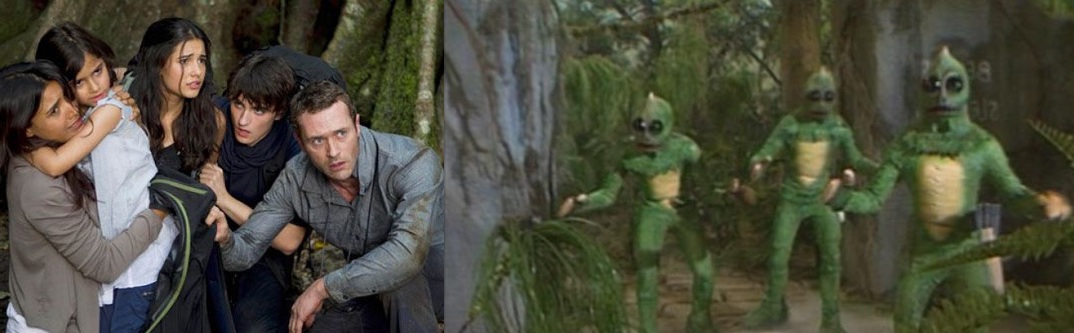
The hero of Terra Nova is Jim Shannon, played by Jason O’Mara. You might remember him as the time-traveling cop from Life on Mars but judging from that show’s ratings you probably don’t. On the one hand he is amping up his sci-fi cred by appearing in two high-profile sci-fi shows but on the other hand what does he play here? Another time-traveling cop. He is close to being typecast, but he could probably clean up selling autographs at the next Comic-Con.
 He’s a pretty affable guy, and when the plot calls for it, can almost pull-off tough. And that’s the problem with the show. While it has a serious sci-fi premise, the producers treat it almost like a WB show; heavy on sappy family stuff with a dollop of fluffy action. And every once in a while they toss in a dinosaur. The show is lightweight.
Terra Nova started off with high hopes but here are some reviews from later in season one:
The show was called “Stargate: SGU by Dr. Seuss” by Mark A. Perigard of the Boston Herald. Sam Wollaston of the Guardian observed that there was only one interesting character and that “A lot of the fault lies with what they have to say to each other. The script is as corny and cheesy as a family-sized portion of cheesy corn nachos.”New York Magazine reviewer Chadwick Matlin vowed never to watch the show again, saying “Sure, the premise had promise, but even masochists like us can only take so much.”
The bad guys dress like Mad Max castoffs with impeccable makeup, the good guys are all portrayed as fluffs, and while this is produced by Steven Spielberg who knows a thing or two about dinosaurs, there are not nearly enough of them to satisfy anyone.
This would be a pretty good Family Channel program.
There is hope, however. Since this is an alternate Earth in a prehistoric era, all the producers need to do in season two is introduce the Sleestaks. Trust me; the ratings would go through the roof.







 Mr. Blog's Tepid Ride
Your Comments