
June 22, 2013

Before you read this, you might want to go back and read this past Sunday’s Sneak Peek of the Week for June 16th, 1943:
On Monday, Lieutenant Allan Keyes will kick Mussolini while he’s down.
Be here on Tuesday when Kellogg’s Pep sponsors the Mr. Blog Review of the new East Side Kids film, Ghosts on the Loose, guest starring Mr. Bela Lugosi!
Wednesday’s blog will be preempted by a special edition of Edward R. Murrow reporting live from a mess hall in Liverpool England.
Mr. Blog returns on Thursday with a new Picture Play featuring movie star Lana Turner. I hope jealous bandleader Artie Shaw doesn’t tune in!
Friday features the regular news commentary I Don’t Believe It. This week, installment 122 takes us to an automated bread bakery in Illinois. Can one machine do the work of as many as ten men?
Lastly, return on Saturday when the Saturday Comic Strip looks back at the time Little Orphan Annie blew up a Nazi submarine.
While the others were all just jokes, the Saturday Comics featuring Annie blowing up a Nazi sub was totally true.

As we all know, Annie is the orphan girl who was too poor to afford eyeballs but was amazingly and only-in-fiction coincidentally adopted by the richest man in the world, Daddy Warbucks. Daddy Warbucks, made his fortune- and hold on to your hat! during the war. Yes, the creator of Annie, Harold Gray, had about as much imagination as your average tomato. (Green, not red.)
Yes, Annie is the always and eternally optimistic (and annoyingly so) The Sun Will Come Out Tomorrow kid but during World War Two she was positively blood-thirsty.
From Wikipedia, for whom the sun will come out at 6:15 pm, according to one of their many inaccurate articles:
When the US entered World War II, Annie not only played her part by blowing up a Nazi submarine, but organized and led groups of children called the Junior Commandos in the collection of newspapers, scrap metal, and other recyclable materials for the war effort. Annie herself wore an armband emblazoned with “JC” and called herself “Colonel Annie”. In real life, the idea caught on, and schools and parents were encouraged to organize similar groups. Twenty thousand Junior Commandos were reportedly registered in Boston.
WHAT? The loveable ragamuffin with the curly red hair blew up a Nazi submarine???? No way was I going to believe wiki on this one, so I found corroboration on The Little Orphan Annie Home Page at http://www.stuartliss.com/loahp/loaww2.html
Her first mission is dramatic enough for any child on the home front longing for a real adventure. She and her friend Panda find a hidden U-boat in a nearby cove, and manage to drag a floating mine to dash against the hull and blow it up.
This was in May of 1942. If anyone has that strip or a link, please send it to me!
![ANN_annie~sandy_shoulders_c [Converted]](https://bmj2k.com/wp-content/uploads/2013/06/annie-caption.jpg)
Back to wacky- I mean wiki:
In the post-war years, Annie took on The Bomb, communism, teenage rebellion and a host of other social and political concerns, often provoking the enmity of clergymen, union leaders and others. For example, Gray believed children should be allowed to work. “A little work never hurt any kid,” Gray affirmed, “One of the reasons we have so much juvenile delinquency is that kids are forced by law to loaf around on street corners and get into trouble.” His belief brought upon him the wrath of the labor movement, which staunchly supported the child labor laws.
A London newspaper columnist thought some of Gray’s sequences a threat to world peace, but a Detroit newspaper supported Gray on his ‘shoot first, ask questions later’ foreign policy. Gray was criticized for the gruesome violence in the strips, particularly a sequence in which Annie and Sandy were run over by a car. Gray responded to the criticism by giving Annie a year-long bout with amnesia that allowed her to trip through several adventures without Daddy. In 1956, a sequence about juvenile delinquency, drug addiction, switchblades, prostitutes, crooked cops, and the ties between teens and adult gangsters unleashed a firestorm of criticism from unions, the clergy and intellectuals with 30 newspapers cancelling the strip. The syndicate ordered Gray to drop the sequence and develop another adventure.
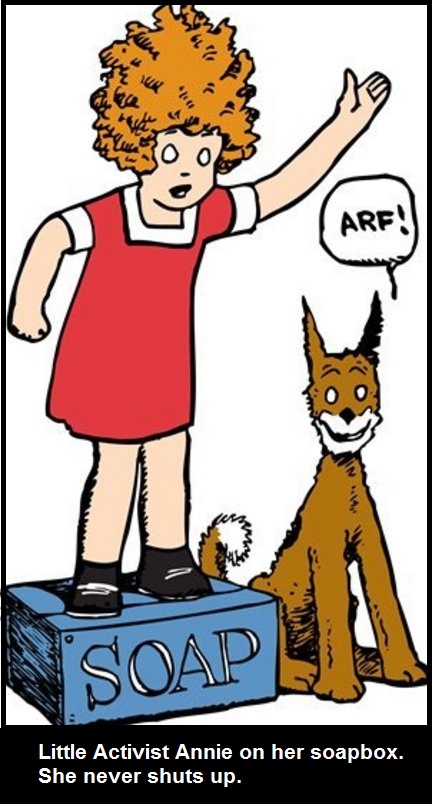
This all came as a surprise to me. I always thought Annie was kind of goody-goody and cloyingly sweet. If I knew that she took on gangsters and foreign spies, and racked up a body count like a Schwarzenegger hero- heck, she’s been jailed in North Korea! I might have been more inclined to read her strips. However, here is current Little Orphan Annie strip:

Sorry folks, Annie was cancelled in 2010.
The last strip was the culmination of a story arc where Annie was kidnapped from her hotel by a wanted war criminal from eastern Europe who checked in under a phony name with a fake passport. Although Warbucks enlists the help of the FBI and Interpol to find her, by the end of the final strip he has begun to resign himself to the very strong possibility that Annie most likely will not be found alive. Unfortunately for Warbucks, he is unaware that Annie is still alive and has made her way to Guatemala with her captor, known simply as the “Butcher of the Balkans”. Although Annie wants to be let go, he tells her that he neither will let her go or kill her—for fear of being captured and because he will not kill a child despite his many political killings—and tells her that she has a new life now with him. The final panel of the strip reads “And this is where we leave our Annie. For Now—”
The June 15th and 16th, 2013 (!) installments of Dick Tracy featured several Annie characters in extended cameos complete with dialogue, including Warbucks, the Asp and Punjab. During these notable appearances, Warbucks spoke on the phone with detective Tracy about a company Tracy thought might be tied to him. Warbucks’ last line in the Sunday strip implies that Annie is still missing and that Warbucks might even enlist Tracy’s help in finding her.
A classic comic strip cross-over! I love it!

This storyline is going on right now. That strip above is only one week old! I’ve just subscribed to this strip, I can only hope they find Annie, now three years later, as some Amazonian warrior-queen wearing a necklace made of the teeth of her enemies.


 Mr. Blog's Tepid Ride
Your Comments