Archive | history RSS feed for this section

A New York Minute (15)

13 Feb

February 13, 2012

Welcome to your New York Minute. What’s up?

Bruce Wayne once said that “criminals are a cowardly and superstitious lot.” That may or may not be true, but if Batman comics have taught me anything, it is that bad guys love their colorful nicknames. and while New York may not be as overrun with arch-criminals as Gotham City, we do have our fair share of interestingly named villains.

The list of New York City Mob nicknames includes Jimmy the Gent, Vinny the Chin, Benny Eggs, Joe Bananas, Crazy Joe, and even Johnny Cash. And while no one has been called The Joker, New York did boast Louie Ha Ha and his brother Bobby Ha Ha.

One man who would have felt right at home in Gotham City was Dart Man, and that was no silly nickname.

In 1990, at least 53 woman were victims of assault by the mysterious Dart Man.

Dart Man was the alias of Jerome Wright, a resident of the Bronx and a former thief and drug dealer. Mistakenly named Dart Man by the press, he assaulted women by shooing pins or needles from  a quote “straw-like device” at their buttocks. None of the women were seriously injured and after posting $1,000 bail the charges were reduced to misdemeanors. He was only charged in two of the cases, there not being anyone able to identify him the other attacks. Most of the needles never broke skin and there were no substances found on the pins. Although he was found competent to stand trial after a psychiatric examination, no motive was found. However, all of his women had one thing in common: They were all light-skinned women attired in business suits or skirts.

The Dart Man attacks came a few months after a gang of girls were convicted of sticking rich-looking women with pins on Broadway in 1989. Interestingly, those attacks seem to be the source of the urban legend of the pin prick attack.

The legend goes that people were randomly pricking people on the streets or in crowds with HIV contaminated needles and infecting unsuspecting people with AIDS. While the 1989 attacks had zero connection with HIV and the needles were clean, this was near the height of the 1980’s AIDS scare and it is easy to see how this legend took off. The kicker of the legend is that the attacks would take place in clubs or late night movies and the victim would have no idea they had been pricked until they found a note in their pocket or stuck to their clothes saying “welcome to the AIDS club.” For the record, there has not been a single case of anything close to that ever happening, but legends like this and of AIDS Mary persist.

New York has a lot of interesting characters. Sometimes too many.

This has been your New York Minute.

An audio version of this legend recently appeared in the amazing FlashPulp website. Check them out for awesomeness and goodies!

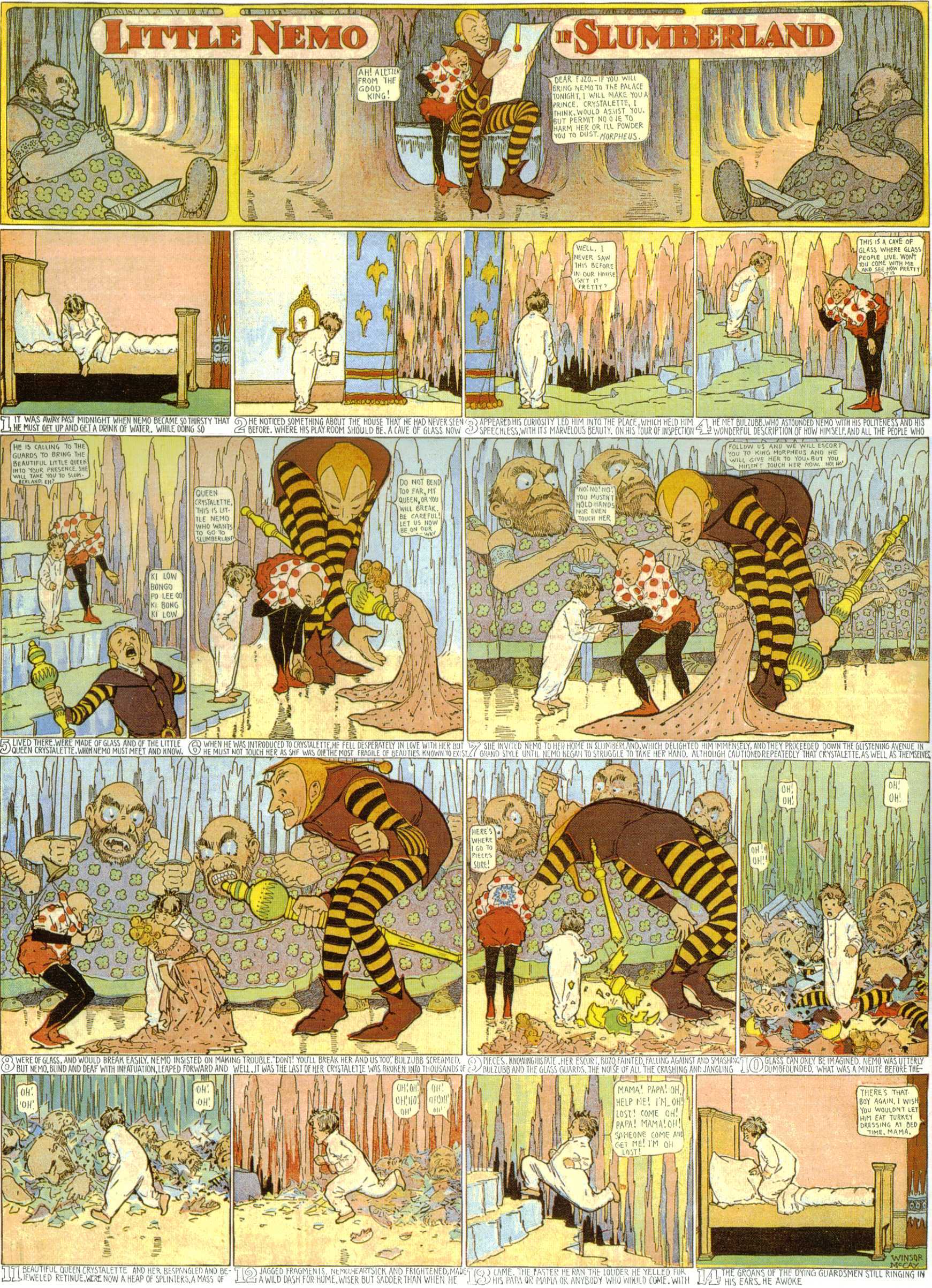
The Saturday Comics: Little Nemo in Slumberland

11 Feb

February 11, 2012

This is easily one of the most revered and influential comic strips ever to grace the newspaper. Little Nemo may not be a household word today (and indeed, it wasn’t in its own time either) but after the gallery I’ll attach a couple of modern homages you may recognize.

From wikipedia, whose Little Nemo entry is unusually  pretty good:

Little Nemo is the main fictional character in a series of weekly comic strips by Winsor McCay that appeared in the New York Herald and William Randolph Hearst’s New York American newspapers from October 15, 1905 – July 23, 1911 and September 3, 1911 – July 26, 1914; respectively.

The strip was first called Little Nemo in Slumberland and then In the Land of Wonderful Dreams when it changed papers. A brief revival of the original title occurred from 1924-27.

Although a comic strip, it was far from a simple children’s fantasy; it was often dark, surreal, threatening, and even violent. The strip related the dreams of a little boy: Nemo (meaning “nobody” in Latin), the hero. The last panel in each strip was always one of Nemo waking up, usually in or near his bed, and often being scolded (or comforted) by one of the grownups of the household after crying out in his sleep and waking them. In the earliest strips, the dream event that woke him up would always be some mishap or disaster that seemed about to lead to serious injury or death, such as being crushed by giant mushrooms, being turned into a monkey, falling from a bridge being held up by “slaves”, or gaining 90 years in age. The adventures leading to these disasters all had a common purpose: to get to a place called Slumberland, where he had been summoned by King Morpheus, to be the “playmate” of his daughter, the Princess.

Sometime during early 1906, Nemo did indeed reach the gates of Slumberland, but had to go through about four months of troubles to reach the Princess. His problem was that he kept being awakened by Flip, who wore a hat with “Wake Up” written on it. One sight of Flip’s hat was enough to take Nemo back to the land of the living during these early days. Although at first an enemy, Flip went on to become one of the recurring heroes. The others included: Dr. Pill, The Imp, the Candy Kid and Santa Claus as well as the Princess and King Morpheus.

The “Slumberland” of the title soon acquired a double meaning, referring not only to Morpheus’s fairy kingdom, but to the state of sleep itself: Nemo would have dream-adventures in other imaginary lands, on the Moon and Mars, and in our own “real” world, made fantastic by the dream-state.


Of all of the various tributes and homages, this next strip may be my favorite. It is a page from Neil Gaiman’s Sandman, itself one of the most revered and influential comics of recent times. although taken out of context, I think the page makes its point perfectly. the characters are all from DC Comics/Vertigo.

And lastly, everyone’s favorite, Spongebob Squarepants!