Archive | health RSS feed for this section

The American Restroom Association

5 Jan

January 5, 2012

A brilliant philosopher once said to me “heated toilet seats are like a gift from the gods. I really wish that they were the norm in all places of poop.”  Frankly I have no idea why she said that. We were standing together by a quiet lake, moonlight glittering on the water, my arms around her, when all of a sudden she came out with that. Totally ruined the mood.

But she has a point. My love life aside, (and what better metaphor for anyone’s love life than a toilet?), when you stop and think about it, what relationship is more important than a man and his toilet? And a woman and her toilet? Doubly so. Let’s be honest. Put a guy in the middle of a forest, in the back of a military cargo plane, or in the audience of his daughter’s third-grade recital, if he has to go, he’s going, toilet be damned. Women are a bit fussier. Hence the wish for heated poop seats by my romantic philosopher friend.

And lest you think I made that quote up, I did not. How did I ever let a woman like that get away?

What sparked my decidedly non-romantic and slightly gross reverie was this little nugget from News of the Weird. Lately the more I watch the network news the more I think I prefer NotW.

In poker, a full house beats a flush, but on a crowded airplane with a broken toilet, a flush beats a full house every time.

We’ve all been there. Broken toilets, no toilets, toilets that look like a burly mountain man eviscerated a grizzly bear in the bowl. We’ve hated it, we’ve complained, we’ve yelled, we’ve thrown things, we’ve resisted arrest, we’ve- what? Sorry, strike that last part. Broken toilets and a big crowd? It’s Lord of the Flies time. But of all the ways of dealing with a lack of toilets, I daresay that none of us gotten involved with a toilet advocacy group. However, I did just that and dove into the cesspool of the internet to do so.

Who would speak for the toilet-less? Who would be the voice of the incontinent? Who would have really funny business cards?

These guys.

Yep, that basic Power Point cell belongs to the American Restroom Association, and if you want to see more basic and simplistic Power Point, hop on over and see for yourself. (And if you happen to be web developer, they can use you.) I checked out their site and expected to find links to bulk toilet paper warehouses or debates on the merits of hard vs. soft toilet seats but I was doomed to be disappointed. This is a very serious organization. They have a mission statement. All serious organizations have mission statements. The Boy Scouts have a mission statement. China has a mission statement. Even Vice President Joe Biden has a mission statement, but he just copied it from some Senator who used to sit next to him a few years back. Check it out the ARA mission statement:
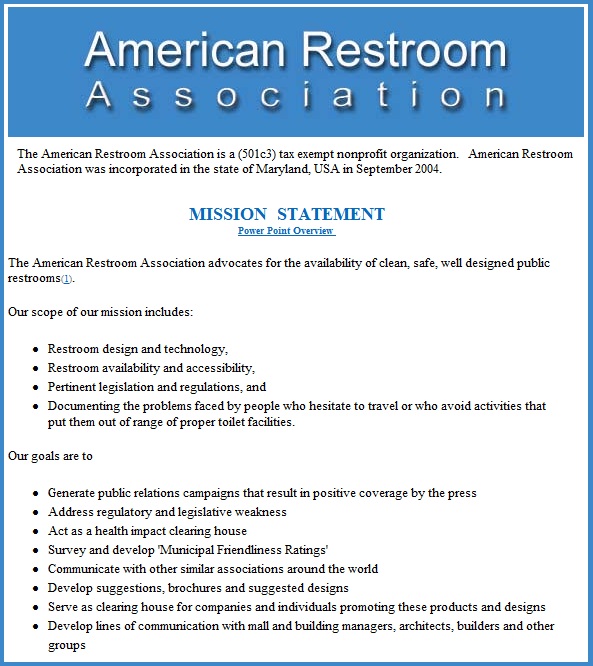
Wow, they’ve really got it going on. They used bullet points and everything. This is a real-deal bunch. One of their goals is to “communicate with other similar associations around the world.” I have no idea if there are any (though I bet France has one) but the site does have a message board so I surfed over to their discussion thread (there is only one) and did some heavy reading. The forum was very surprising.

Frankly, I was surprised that anyone used it at all.

But the site does feature some important information. For instance, do you know what a restroom is? Or what a pay toilet is? Oh, I am sure most of you think you do, heck; many of you may be sitting on one as you read this, but I for one felt just a little ignorant after reading their definitions.
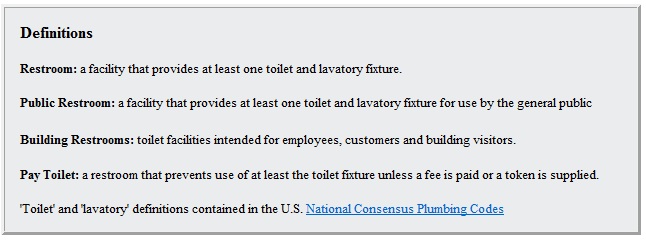
Not only do I finally know the official definition of a public restroom (I always wanted to know!) but I also know that a pay toilet requires a fee and that the US government has its collective head stuck in a toilet for coming up with a code for that. Seriously, our tax dollars, flushed away.

The site is full of important and vital information, I suspect, though I seem to have missed all of it. Maybe there was another Power Point?
And why couldn’t they use a bigger font? I hope whoever designed this thing knows his toilets better than his html.

All evidence to the contrary aside, the ARA is robust organization. Look at their upcoming events:


I am really bummed that I missed World Toilet Day 2011, but in my house every day is Toilet Day. Honestly, can you imagine a day without a toilet? My mind shudders with the horror. And I want to find out more about the World Toilet Summit. It sounds like the perfect place to host the first annual Mr. Blog’s Tepid Con. Let’s book a hotel now! But where to hold it? Flushing Queens comes to mind.

However, I do not want you think that I am making fun of this issue. “Places of poop” is a serious matter. Check out this piece of “poop culture:”
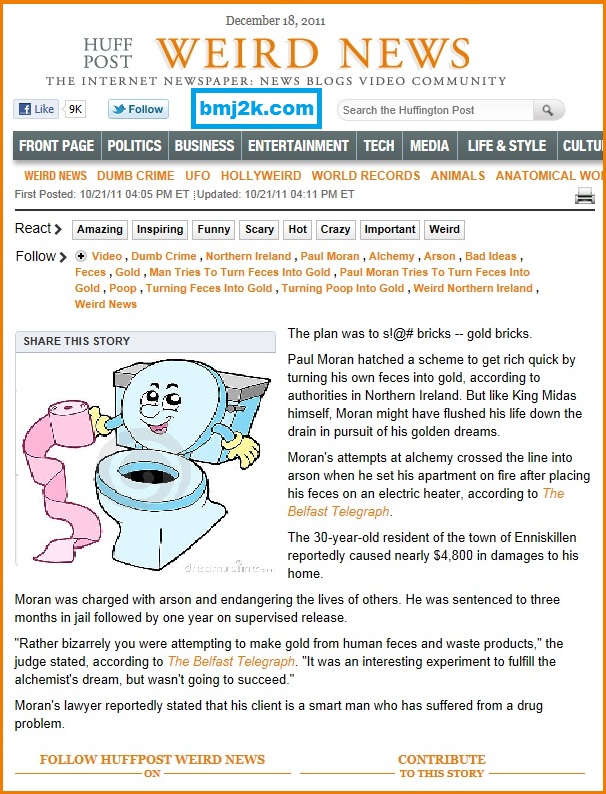
I’ve heard of manna from heaven, but manure?

Who doesn’t dream of turning his own feces into gold? For centuries, alchemists sought ways of turning lead into gold, why not shit? Face it, none of us has any lead just lying around, but nobody runs out of human waste. All that waste just flushed into the cesspool, septic tank, the ocean, or some kid’s wading pool depending on what municipal regulation you are flouting. Why let some stranger turn your crap into gold when you can do it yourself?

Is it just me, or does it often seem that the stupider people are, the more ingenious they try to be? Sure, this fool could have stayed home, mystified by the bright lights on his television set, but his animal cunning, and likely animal-level IQ, led him to save his poop and dry it on a space heater. Is it really so stupid? Even if he never made a single ingot of gold, he had a really cool composting program going on. Too bad he lived in a fifth floor apartment.

I attempted to contact the American Restroom Association for their opinion on turning poop into gold but unbelievably they never got back to me. They must be very busy gearing up for January 17th, International Quilted Toilet Paper Day. The highlight of the festivities will be the unveiling of the world’s largest roll of toilet paper in Czechoslovakia. The first sheet will be ceremonially pulled off the roll by none other than Honorary ARA International Ambassador Regis Philbin, schedule permitting.
A New York Minute (8)

26 Dec

December 26, 2011

Welcome to your New York Minute.

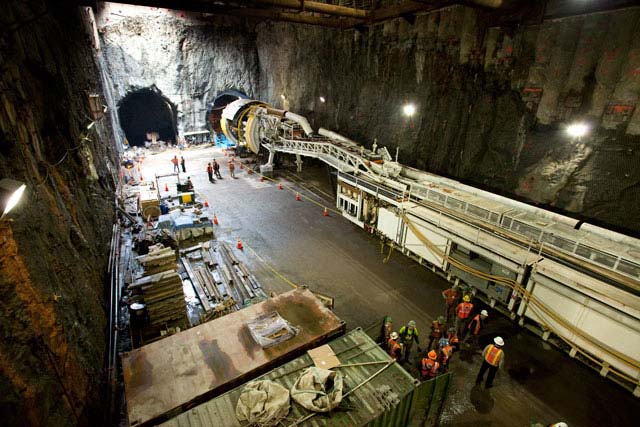
I’ve got progress on my mind this week, and in New York, progress can be agonizingly slow. Take the Second Avenue subway. It was first proposed in 1929 but only since 2006 has there been any progress.

But progress may not be all that it is cracked up to be. Here are some short quotes from a New York Times article from just a few years back.

Ah, the native sounds of a summer evening on the Upper East Side: hooting owls, honking cabs, chattering crickets. And, occasionally, the banshee-like shrieks of an air horn, followed by rumbling explosions that call to mind a Messerschmitt raid.

Nope, it’s not World War II — just the Second Avenue subway.

Residents along this cheerless East Side stretch have long wondered whether these late-night blasts are necessary for the construction of the new underground line, a 1.7-mile route that has been planned since the Great Depression.

And while the explosions may be deafening, the Metropolitan Transportation Authority now says it hears the public outcry loud and clear.

Starting on Monday, underground blasting will be banned after 7 p.m. along the Second   Avenue corridor, transit officials said. The moratorium, according to the transportation authority, was hashed out after discussions with local politicians and community leaders.

“People don’t want to have a romantic dinner with the sound of pavement being obliterated in the background,” said the project’s construction chief.

The project’s contract originally allowed for the blasts to continue until midnight, although Dr. Horodniceanu noted that the explosions usually stopped “after 9 p.m.”

That’s right. In the heart of one of the most populous parts of the most populous borough, the city was blasting the street apart with dynamite until midnight. You can imagine the disastrous effect the work had on the neighborhood. Hundreds of small businesses in the construction zone have closed, and that wasn’t even due to the blasting, it was due to the massive street closures and traffic disruptions which dropped foot traffic to near-zero.

But the story gets worse. Here are some excerpts from a New York Daily News article from earlier this week.

Blasting on the Second Ave. subway project was temporarily halted Tuesday amid a storm of complaints from upper East Siders about dust.

Long-suffering residents living with the constant tunneling are up in arms over the clouds of dust that appear during the underground explosions carving out what will be the 72nd St. station.

Community Board 8’s Second Avenue Subway Task Force Committee got an earful Tuesday night from 60 locals griping about pollution, noise and “the Second Ave. cough.”

Pressman said she went to her doctor after getting sick recently and was told, “‘You’ve got the Second Ave. cough!’”

Joan Schoenberger of E. 70th St. agreed that it’s become hard to breathe in her neighborhood.

“There’s a big smoke cloud,” Schoenberger said. “It’s very pervasive around that area.”

The audience packing the meeting at the New York Blood Center on E. 67th St. broke into applause when they were told blasting has been temporarily suspended until Dec. 5.

“We did that because we heard loud and clear from the community and elected officials, though it’s an impact to the construction schedule, and to workers,” said Bill Goodrich, the Metropolitan Transportation Authority’s senior vice president of capital construction.

Goodrich said the MTA will work on modifications to reduce dust, including revamping exhaust systems, over the next two weeks.

He wouldn’t say how many workers would be laid off, but he expects them all to be rehired when blasting resumes.

Assemblyman Micah Kellner (D-Manhattan) lamented the layoffs, but said, “We just can’t lived with Second Ave. being blanketed by dust each time they blast.”

“The MTA needs to insure our air quality,” Kellner said.

Tunneling for the first phase of the subway was finished in September. It will take five more years to build stations and lay tracks before the subway can open.

Yes, five more years. For a project that was considered a necessity even in 1929, completion in 2016 is ridiculous.

All of this put me in mind of the original subway construction early in the last century.

The following info was found online at generalcontractor.com

Ground was broken (for the subway) in March 1900 in Manhattan. The construction company chose shallow cut and cover as the excavation method to avoid having to tunnel deep under New York’s infrastructure. Wooden planking and bridges covered the construction so that traffic could continue over the tunneling that would go on for years.

The construction that was typical for the majority of the project was a flat roof I-beam construction with a concrete bottom. The side walls had I-beam columns five feet apart, with vertical concrete arches between the columns. The I-beams supported the masonry, allowing the walls to be built thinner than they could have been if concrete alone was used. The tops of the wall columns were connected by roof beams, supported by rows of steel columns between the tracks. They were built on concrete and cut stone bases. Because the tunnels were susceptible to water damage from the ground, several inches of felt washed with hot asphalt were laid behind the walls, over the roof and under the floor. In some places, this method of waterproofing was reinforced with one or two courses of brick. Terra cotta ducts for the electric cables were placed between the steel columns and waterproofing.

The station on 42nd Street between Park Avenue and Madison Avenue required a special method of construction. Five subway tracks passed through this area, and the excavation reached a depth of 35 feet and extended 15 feet into the rock. In order to construct this segment of the subway, a 30-foot wide trench had to be sunk on the south side of the street, in which the subway was built for the width of two tracks. At 50-foot intervals tunnels had to be driven toward the north side of the street, with tops four feet above the roof of the subway and bottoms on the roof. The ends of the tunnels were connected by a parallel tunnel just beyond the line of the fourth track. Workers were then able to excavate the rock in the bottom of the tunnels to their final depth. A bed of concrete was then placed in the parallel tunnel, and a third row of steel columns was erected in order to support the concrete and steel roof.

One hundred years ago the work was done without building-rattling midnight explosions and toxic dust clouds. Yes, it was hard work and manpower intensive, but it took great pains to minimize disruption to the city at large. For a project that even its biggest critics agree is a necessity but is still nowhere near completion, I have to wonder if the people in charge have any idea of what they are doing.

Stores going out of business, nightly blasting, and the air making people sick. This is progress?

This has been your New York Minute.

An audio version of this legend recently appeared in the amazing FlashPulp website. Check them out for awesomeness and goodies!