Archive | comics RSS feed for this section

The Saturday Comics: Ben Casey by Neal Adams

10 Sep

September 10, 2011

Ben Casey was a TV medical drama that ran from 1961 to 1966. It was one of the most popular shows of the time and was referenced or parodied everywhere from popular music (“Callin’ Dr. Casey” by John D. Loudermilk) to The Flintstones. (“Monster Fred” from season five with Doctor Len Frankenstone, who switched Fred’s brain for Dino’s. Gotta love The Flintstones.)

When I was young I saw a couple of episodes and today it is, as far as I can tell, not broadcast anywhere. It is just another old TV show. But this is The Saturday Comics, not The Saturday Old TV Shows. So why am I talking about Ben Casey?
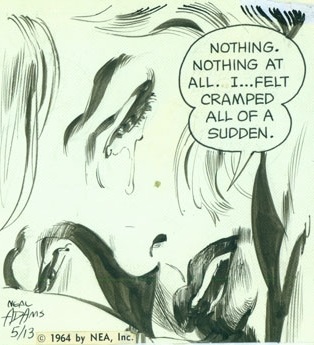
That’s why.

That’s a great piece of Neal Adams art, and he did it daily on the Ben Casey comic strip.

If you don’t know Neal Adams, feel free to turn in your pop culture badge now and walk away.

Some bits of his wikipedia bio:

Neal Adams is an American comic book and commercial artist known for helping to create some of the definitive modern imagery of the DC Comics characters Superman, Batman, and Green Arrow; as the co-founder of the graphic design studio Continuity Associates; and as a creators-rights advocate who helped secure a pension and recognition for Superman creators Jerry Siegel and Joe Shuster.

Adams was inducted into the Eisner Award’s Will Eisner Comic Book Hall of Fame in 1998, and the Harvey Awards’ Jack Kirby Hall of Fame in 1999.

Green Lantern/Green Arrow and “relevant comics”

Continuing to work for DC Comics during this sojourn, while also contributing the occasional story to Warren Publishing’s black-and-white horror-comics magazines (including the Don Glut-scripted “Goddess from the Sea” in Vampirella #1, Sept. 1969), Adams had his first collaboration on Batman with writer Dennis O’Neil. The duo would later revitalize the character with a series of noteworthy stories reestablishing Batman’s dark, brooding nature and taking the books away from the campy look and feel of the 1966-68 ABC TV series. For now, however, they would do only two stories, “The Secret of the Waiting Graves” in Detective Comics #395 (Jan. 1970) and “Paint a Picture of Peril” in issue #397 (March 1970), with a short Batman backup story, written by Mike Friedrich, coming in-between, in Batman #219 (Feb. 1970). Batman’s enduring makeover would come later, after Adams and O’Neil’s celebrated and, for the time, controversial revamping of the longstanding DC characters Green Lantern and Green Arrow.

Rechristening Green Lantern vol. 2 as Green Lantern/Green Arrow with issue #76 (April 1970), O’Neil and Adams teamed these two very different superheroes in a long story arc in which the characters undertook a social-commentary journey across America. A major exemplar of what the industry and the public at the time called “relevant comics”, the landmark run began with the 23-page story “No Evil Shall Escape My Sight” and continued to ” …And through Him Save a World” in the series’ finale, #89 (May 1972). Wrote historian Ron Goulart. These angry issues deal with racism, overpopulation, pollution, and drug addiction.

Here is a sample of his amazing Batman covers, featuring issues from my own collection.

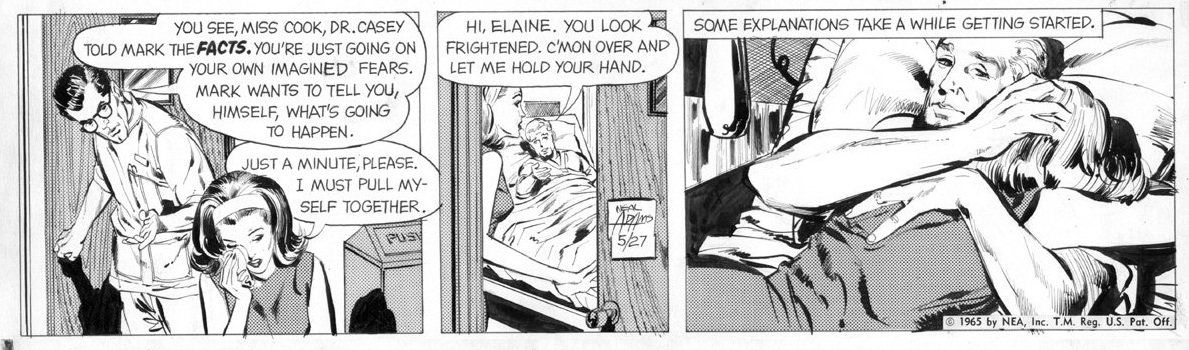
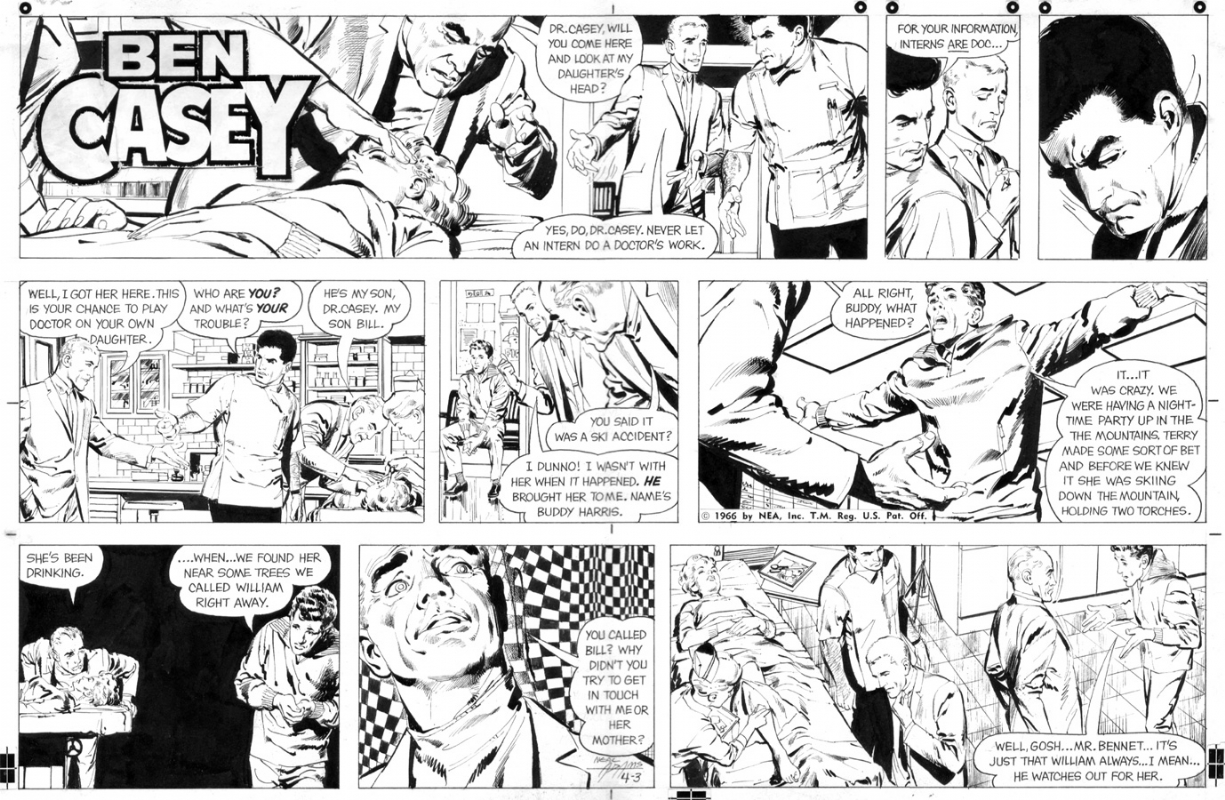
He didn’t take the easy way out with Ben Casey either.

Comics historian Maurice Horn said the strip “did not shrink from tackling controversial problems, such as heroin addiction, illegitimate pregnancy, and attempted suicide. These were usually treated in soap opera fashion … but there was also a touch of toughness to the proceedings, well rendered by Adams in a forceful, direct style that exuded realism and tension and accorded well with the overall tone of the strip”.

So feast on Neal Adams’ craft on the Ben Casey strip, a craft which is almost too good for a daily newspaper comic.

How Dark Shadows Ruined The Vampire.

5 Sep

September 5, 2011

I just finished a Dark Shadows marathon. I watched 1,225 episodes, two original cast movies, and the 12 episode 90’s revival in just about a year and a half. On top of that I also listened to four modern Dark Shadows audio dramas and read both a series guide and six novels published as the show ran in the late 1960’s. Throw in the collection of comics by Gold Key and it is fair to say that yes, I know a little bit about Dark Shadows.

For those not in the know, Dark Shadows is a soap opera that ran from 1966 to 1971 on ABC. Unlike nearly every other daytime drama of the time, every episode exists, minus one, but that episode’s soundtrack survives so it is the most complete- by far- show of its type. Compare that to Doctor Who whose shows of that era have almost as many lost as there are still in existence.

The show was a dark and spooky half-hour drama (done on a tiny budget) that regularly featured ghosts, werewolves, time travel, witches, spiritual possession, mad scientists, Frankenstein-like creatures, parallel worlds, immortal Phoenixes, and vampires. And if you know the show there is one name that leapt to mind as soon as you saw “vampires,” Barnabas Collins. 

And he was not just any vampire. Dark Shadows is widely credited with the creation of the modern conflicted vampire. Barnabas Collins was turned into a vampire by a witch’s curse, and instead of destroying him, his father chained him in a coffin. 200 years later he was freed and met a doctor, Julia Hoffman, who cured him. Barnabas would revert back to vampirism a few times over the course of the series, but he was usually a tragic figure, hating what he had become, longing to be human again, and generally becoming the romantic hero of Dark Shadows.

And that is why I hate him.

Until Barnabas vampires were universally characterized as evil. Though Bram Stoker’s Dracula defined the modern vampire, with some help from a few Gothic forebears, the contemporary Twilight vampire and others of that immature ilk all descend from Barnabas Collins.

Take the classic vampire. To be concise I’ll skip the ancient creatures of mythology and proto-religion and move to the 18th Century.

The OED dates the first appearance of the word vampire in English from 1734, in a travelogue titled Travels of Three English Gentlemen. However, the word itself has roots going back to Eastern Europe as early as the 11th Century.

Vampires were usually reported as bloated in appearance, and ruddy, purplish, or dark in color; these characteristics were often attributed to the recent drinking of blood. Indeed, blood was often seen seeping from the mouth and nose when one was seen in its shroud or coffin, and vampires of the Balkans and Eastern Europe had a wide range of appearance ranging from nearly human to bloated rotting corpses.

None of them sparkled.

Gothic writers like Sheridan Le Fanu added beauty and sexuality, and Bram Stoker added class and refinement, but one thing remained constant: The vampire was a creature of unrepentant evil. And more importantly, he was always an animated corpse. Vampires are classically feared as revenants of evil beings, suicide victims, or witches, but they can also be created by a malevolent spirit possessing a corpse or by being bitten by a vampire. Vampires are distinctly creatures of the supernatural or demonic realm.

Dark Shadows was also one of the early (though not the first, Richard Matheson explored this theme too) depictions of vampires being cured through scientific methods, which is totally at odds with the “black magic” or demonic origins of the vampire. It was never really clear, nor did it really make sense, how a series of blood transfusions cured Barnabas Collins’ witch’s curse.

Teenage fiction is full of nobly conflicted vampires, utterly handsome, all needing the love of that one girl to turn him around. They are the rebellious bad boys who really aren’t that bad at all, deep down. Dark both in personality and looks (despite somehow also being pale) and brooding, they are the property now of the teen and adolescent.

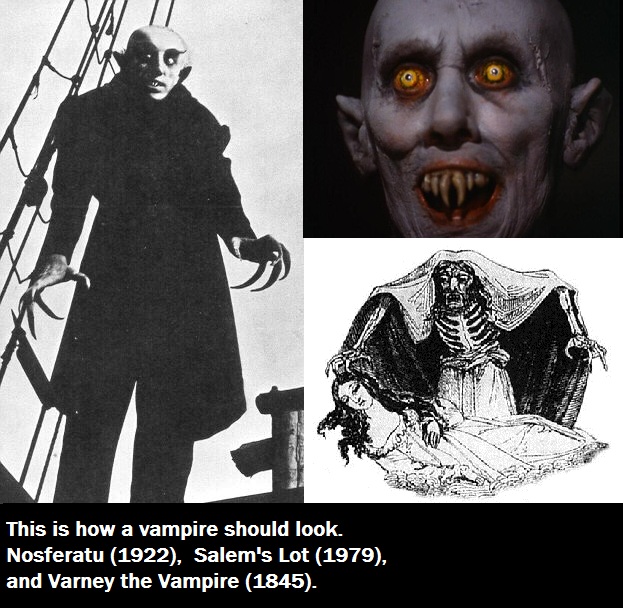
And that is a damn shame because the vampire should be the boogey man in your closet who comes out not to whisk you into a fantasy world of delight but to rip your throat open and gorge himself on your blood as it sprays gristly crimson ichor across his face. And that face shouldn’t inspire love or lust, the vampire’s face should inspire extreme fear, panic, and revulsion, but most of all, it should be the last thing you see before you pass out or die.

Vampires are not handsome. They are repulsive and loathsome creatures whose breath reeks of the grave. They have moldy dirt under their fingernails from crawling out of the earth and their skin is more than pale and pasty, it is almost translucent, stretched over their body too tightly and their teeth seem long only because their gums have receded and withered. They are animated corpses.

Vampires are not charismatic. They are cunning like animals, like wolves. They do not throw elegant dinner parties. Like rats, a vampire may crawl on the ground through the mud to bite your ankle and in centuries past anyone asleep in a field kept his shoes on at night lest a vampire suck the blood out of their heels. No romantic embraces for them, for a vampire is past the point of love or romance. They are malevolent killers.


One of the great ironies of Dracula, and one of the great bits of Stoker’s writing (of which I otherwise have many faults) is that Count Dracula arrived in England on a ship called the Demeter. Demeter was the Greek goddess of the harvest, a life-bringer. Dracula brings only death.

I loved every minute of Dark Shadows, even the early episodes where there was little supernatural and the drama revolved around the threat to the Collins family shipyards. And I loved Barnabas Collins, even if he did single-handedly ruin the vampire genre for decades to come.