Archive | February, 2011

Am I A Public Figure?

18 Feb

February 18th, 2011

A “public figure” is generally defined as a well-known or notable person. There is also a more precise legal term dealing with libel, slander, and defamation but since I am not contemplating any lawsuits I am not interested.

The term “public figure” takes in a broad range of people yet makes no distinction between celebrities or politicians, good role models or bad, famous or infamous. For example, a list of public figures may include:

Gandhi
Charlie Sheen
Stephen Hawking
Sally Ride
The Unabomber
Roger Clemens

As you can tell, most if not all of those names are recognizable no matter where you live. As the definition of “public figure” makes no distinction between “good” or “bad,” neither does the definition make a distinction based on geographical location. This therefore includes public figures who seemingly have no geographical location and are primarily found online, like Matt Drudge or Perez Hilton. Much like Gandhi and the Unabomber, no matter where you are people will know them, despite the fact that no one can tell you where Drudge or Hilton actually live.

It also does not matter how widely you are known. The Mayor of Toledo Ohio is a public figure despite not having been heard of in 99.999% of the United States.

Therefore, if being a public figure is not dependant on where you are, and it doesn’t matter how widely you are known, then it stands to reason then that alongside those public figures known countrywide or globally, there must also be local public figures known in smaller circles or communities. So my question is, if there is no upper limit, is there a lower limit? What is the threshold?

Am I a public figure?

I have already established that bloggers can be public figures. However, I am nowhere near the level of a Matt Drudge, Perez Hilton, or journalists who write for online news sites. But since I have already shown that the geographic size of your reach doesn’t matter, neither should the number of page views. Both show the level of distribution. And it doesn’t matter if I use my real name or not, unless you believe that Perez Hilton has that name on his birth certificate. (He was born Mario Armando Lavandeira, Jr.)

So if I am not as well-known as the big bloggers, and I am not known by nearly as many people, what, if anything, do we have in common that would make me a public figure?

What I believe we have in common is the fact that I put out my blogs for public consumption. That’s the key- public consumption. My site is available anywhere, all the time, for everyone. My blogs are intended for a large, broad audience of anyone and everyone who may find the site and read the content. There is no restricition, no privacy filter. By putting myself on a public stage I believe I have made myself a public figure. So let’s go back to the definition of “a well-known or notable person.” I won’t argue that I am a notable figure. I will defend my argument on the “well-known person” definition.

What is a “well-known person”? There is no precise definition. You could argue that a person who is well-known is someone who would be known by the majority of average people. By that logic, Dave Barry, a syndicated American columnist who has written thousands of columns, dozens of books, had movies based on his novels and a sitcom based on his life (“Dave’s World”) is not a public figure in France since the French are unlikely to know of him. That would make him an “American public figure,” but since we have seen that geographic location has no validity in the definition of a public figure, that can’t be. So Dave Barry is a public figure whether the French know him or not. (If you’ve read his work you know that Dave may appreciate that.)

So therefore, if a majority of people don’t know me, that doesn’t matter. What it comes down to is that I have put myself on the public stage so that I have the potential to be well-known. I am on the same public stage as Dave Barry, Darryl Strawberry, and Vince McMahon, just much farther back and in the shadows near the wings.

It also puts me on the same stage as Snookie, Paul Teutul Sr, and Sal the Barber from Scrappers, a fact which I feel comes with a certain level of irony.

I am, of course, not nearly as famous as Donald Trump’s hair, let alone Trump himself, and I don’t claim to be. I’ve got my little corner of the internet and in my little slice of Heaven, I am the most well-known public figure of all.

———
Just a quick Thank You and shout out to the Collective Detective stories at Skinner.fm, which got me thinking about this subject and I think the best compliment I can give JRD is the fact that I found his tales thought-provoking (as well as interesting.)

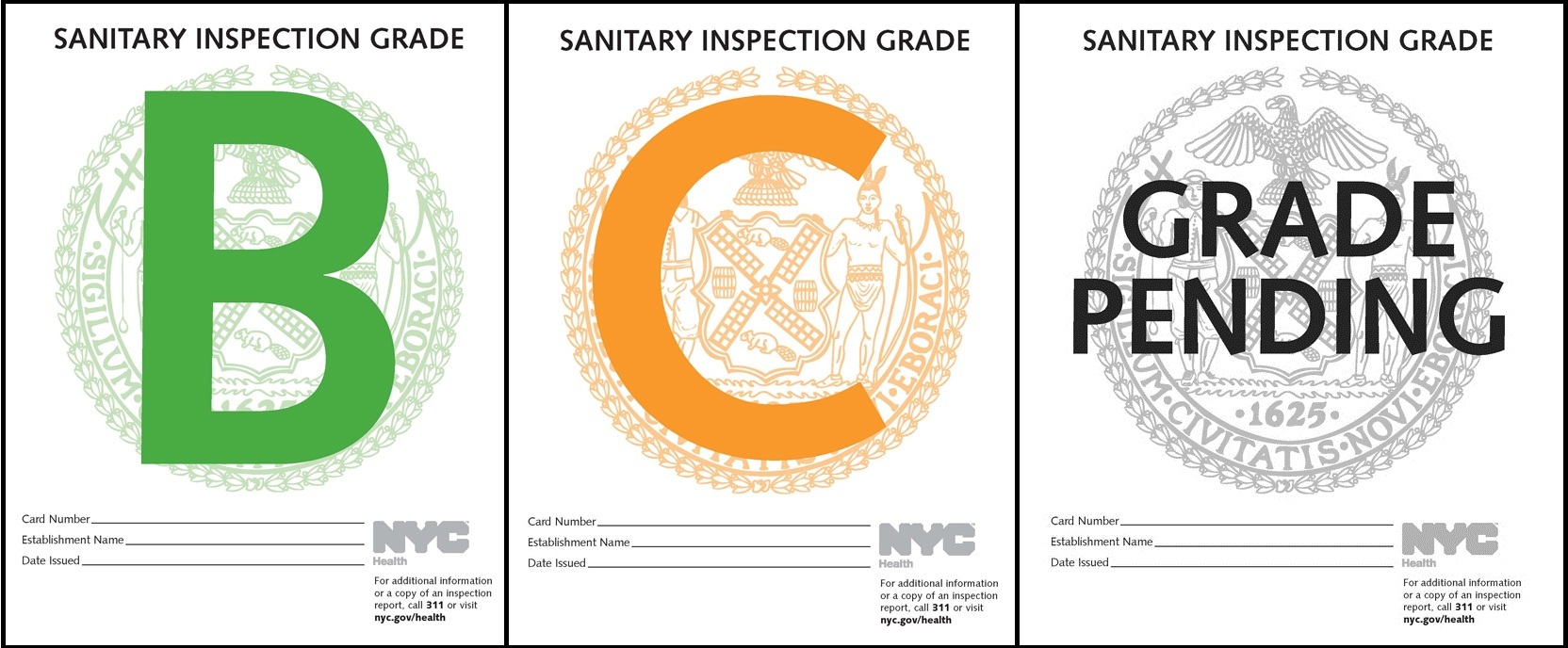
Mayor Bloomberg’s Alphabet Soup

17 Feb

February 17, 2011

I tend to criticize Mayor Bloomberg quite a bit, and rightly so. For example, while addressing a group of Irish businessmen last week he started his speech with a drunken Irishman joke. As you may imagine it didn’t go over so well.

However, I do tend to give credit where credit is due. On thing he did that I like is that restaurants now have to post their ratings from the Department of Health on their front windows or doors so you can decide if you even want to go in. Of course, these big signs are right at eye level and ruin the look of the restaurant but I guess that is a small price to pay.

The problem is that you never see anything but A ratings. That means one of two things. Either every restaurant is in sparkling compliance or the inspectors are doing their usual lousy job. There is an A-rated take-out place a block away from me that has had the same greasy stains on the wall since the Clinton administration (which, ironically, also was noted for a notorious stain.) Needless to say I don’t eat there.

Seeing all those A-rated stores had me pretty jaded until I saw a store proudly displaying a B rating. OK, pride had nothing to do with it, they legally had to post that sign.

As you can see from the image above, the lowest rating, which I have yet to see, is a C. The Grade Pending sign means that the restaurant received either a B or a C and is contesting it. Here is how the City of New York explains it:

A restaurant that receives a ‘B’ or ‘C’ on its second inspection can opt to post a ‘Grade Pending’ card in the window while it waits for a hearing before an Administrative Tribunal at the Health Department.

Once the Tribunal rules on the inspection, the final score is recalculated and the restaurant must post the grade it receives.
 
In other words, if a restaurant has a ‘Grade Pending’ sign, it had enough violations to earn a ‘B’ or a ‘C’ and it is contesting the low grade.

So why would a store post a B rating? If I understand correctly, and as a product of the NYC school system I may not, that means that the restaurant got a B or a C, had the chance to fix it, and didn’t. Right away that is a warning sign. If they are so lazy that they won’t do some work to get an A, how much effort are they putting into my grilled chicken wrap?

The problem is, who knows what these ratings mean? Why did they get a B? The reason may have nothing to do with the food. If a store got a B because of a blocked fire door or not enough seating, I would still order take-out. The reason needs to be posted on the sign.

I found this article on, of all places, http://www.wqxr.org. WQXR, 105.9 fm, is New York’s classical music station.

If a restaurant fails its health inspection, you might think it had rats, mice or roaches.

But sometimes, all it takes is a bunch of seemingly minor violations involving something as simple as the scoops used to take ice cubes out of a bin.

“Ice scoops can never be kept in the ice, ever,” said Neil Kleinberg, who owns Community Food and Juice, a restaurant near Columbia University.

The rationale is if you leave the scoop in the ice machine, it’ll get buried under falling ice, and then you’d have to dig it out with your potentially dirty hands, contaminating ice cubes that could later be chilling someone’s Diet Coke.

These types of violations can add up quickly and with a new restaurant grading system on the horizon, restaurants may have to work harder to keep their doors open.

I think I would take my chances with that place. I may order my Diet Coke without ice but I’d eat there.

Kleinberg, who supports the city’s move toward a public letter grade system, took me on a tour of his 120-seat restaurant. In the basement he pointed out other Health Department rules. For example, signs reading “Employees must wash hands before returning to work” have to be on display in bathrooms, and bathroom doors must have a self-closing hinge. A bathroom door can never be left open because flies could move in and out and then contaminate your chocolate cake.

A violation for an “employees must wash hands sign” is meaningless to me. Yes, I want the employees to wash, but sign or no sign, there is no enforcement. How could there be unless they are going to post lookouts in the bathroom, and that would be more off-putting to me than the lack of sign. I don’t want a look-out in the bathroom keeping an eye on things.

As for the hinge, doesn’t the door open and close anyway whenever someone enters or exits? What fly sees the self-closing hinge and gets so intimidated that they find another bathroom to inhabit? I’d think that the fact that bathroom was dirty enough to attract flies in the first place was a bigger problem.

The bottom line is that having a little bit of information is almost as bad as having no information. So while I do commend Mayor Bloomberg for the initiative, I give him a C rating for half-assing it.