Tag Archives: Saturday Comics

The Saturday Comics: Ching Chow

27 Aug

August 27, 2011

Ching Chow was an unusual strip, in more ways than one. It wasn’t as much a strip as it was a daily fortune cookie. Each day, Ching Chow, in the midst of some strange predicament, would dispense some old-fashioned wisdom, philosophy, or aphorism. The strip began in 1927 and ran with little change until 1980 and it is easy to see why it ended. Ching Chow was a typical Chinese stereotype from back in the 1920’s and didn’t change much over the years. He was originally created by Sidney Smith and Stanley Link, but by the time it was over Henri Arnold was doing the strip. When Ching Chow was cancelled, it was apparently still popular enough that it was replaced by Meet Mr. Luckey, an almost identical though less-offensive Henri Arnold creation. Mr. Luckey seems to be a leprechaun, thus explaining the lucky aspect of his name, but in the strip I’ve included below he doesn’t seem very lucky.

Ching Chow was also unusual in that, at least in New York, it didn’t run in the comics section. It was an anomaly in the modern era because of its size. Unlike most other single-panel strips, this one was one newspaper column wide. That was a popular size in 1904, for example, because most papers didn’t have a comics section but could easily drop a comic panel into a column of newsprint. Today that makes it hard to fit into a comics page where all the other comics have standard sizes and Ching Chow/Meet Mr. Luckey don’t fit. In the New York Daily News it was always placed somewhere in the sports section among the statistics.

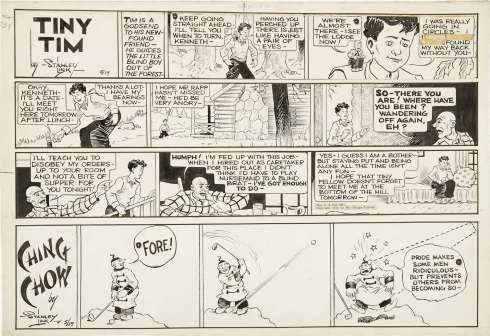
I have also included the only instance I found of a Ching Chow topper, placed at the bottom (yet still technically a “topper”) of a Tiny Tim strip. It is easy to see why Tiny Tim doesn’t run today. The Ching Chow strip below it is far better, playing off the panel borders for its gag.

I also really appreciate this patriotic strip from World War Two:

The Saturday Comics: Grandma

20 Aug

August 20, 2011

I came across this strip while I was searching for Agatha Crumm.

Created by Bill Hoest (The Lockhorns), Agatha Crumm began in 1977 and ran until 1996. She was the owner of the Crumm Cookie Company and broke the cliché of the sweet little old lady.

I like Agatha Crumm but it was Grandma that caught my eye. 

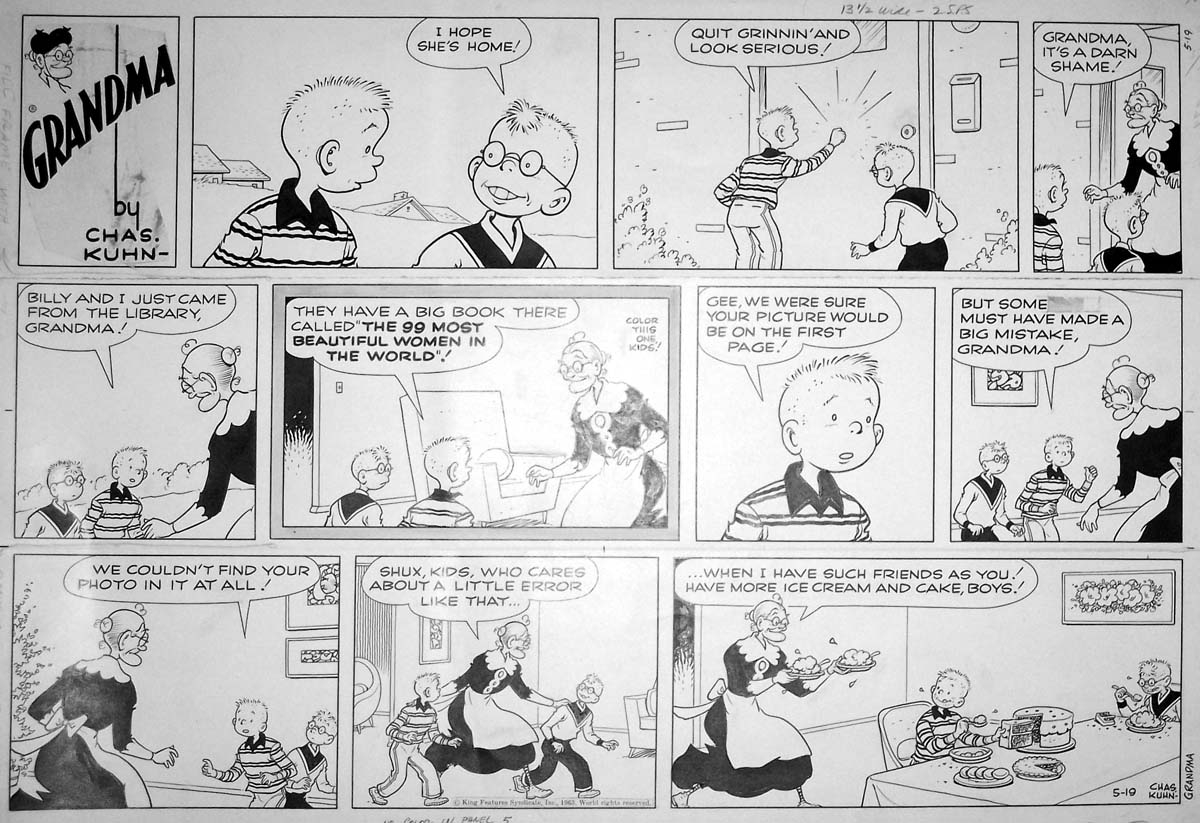
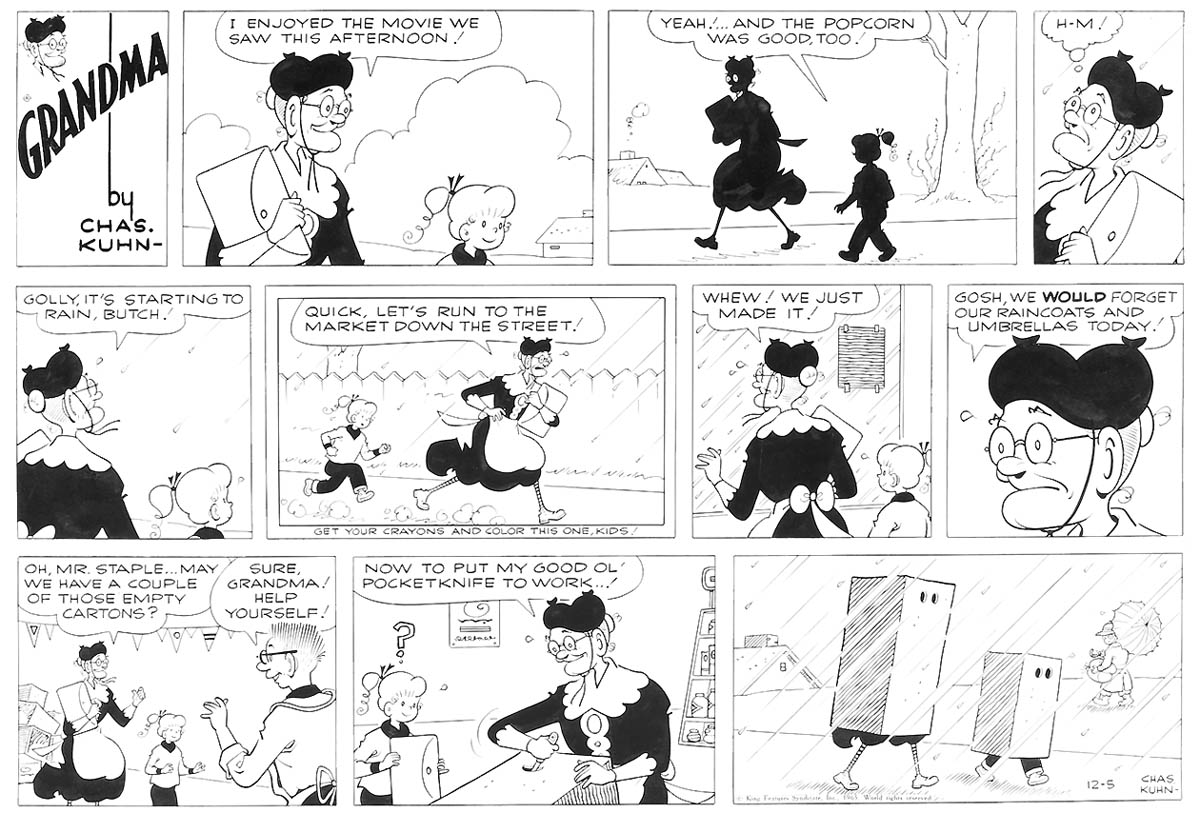
It was the creation of Charles Kuhn and ran from 1947 until 1969, eight years before the more progressive Agatha Crumm debuted.

From Toonopedia via wiki:

The strip depicted humorous events in the life of a friendly, fun-loving woman known to her friends and neighbors only as Grandma.

In Toonopedia, comics historian Don Markstein described the character:

Grandma was known by no other name, to children and grownups alike, despite the fact that she gave no evidence of having actual progeny of her own. Like the much earlier Lady Bountiful, she palled around day in and day out with the neighborhood kids; but unlike her, Grandma wasn’t interested in improving them. She was just having fun. Otherwise, she kept busy around the house, but of course, the household chores included a lot of baking. Kuhn derived much of her character from his own mother, who, in her dotage by most standards, was always ready to dress up, sing, and even dance a jig to help out a small theatrical production put on by her friends, the children of the neighborhood.

As Kuhn recalled:

My mother was always full of pep and vigor. One time at 75 years of age, she dressed up in my old Navy uniform, danced a jig and played a piece on her French harp just to help the neighborhood kids put on a backyard show. My comic Grandma, in spirit at least, is my own beloved mother.

It is important to note that the Sunday strips reprinted below were published in color. Look for the panel in or near the middle labeled “Color this one, kids!” One panel was always left uncolored in black and white for the kids to color in themselves. I think it was wonderful that Kuhn remembered that these strips were for kids.

The tone of the strip is unabashedly sweet and charming, and the feelings and emotions it depicts would be considered old-fashioned today, and even in the strip’s own lifetime too as is entered the late 1960’s. For me, the nostalgia and obvious love that glows from it is the appeal to me.