
June 4, 2011

Who Knows What Evil Lurks In the Hearts Of Men?
The Shadow Knows!
I refer, of course, to perhaps the most famous show OTR ever produced.
 So who was The Shadow?
“Years ago in the Orient, The Shadow learned a strange and mysterious secret, the ability to cloud men’s minds so they cannot see him”
Or “using advanced techniques that may one day be available to law-enforcement, The Shadow fights crime as invisible as the wind, as inevitable as a guilty conscience.”
In his everyday identity, The Shadow is “Lamont Cranston, wealthy young man about town.”
Or an amateur criminologist. Or sometimes he was the best friend of the police commissioner.
Usually he was just some rich guy who stumbled into plot to rob a bank, or spent the night in a haunted mansion, or ran into his double, who just happened to be newly released from prison and planned to frame Cranston for war crimes or something. The show ran for almost three decades so the quality depends on when the episode was made. It could be a supernatural show with ghosts one season, a show where Cranston foils attempts at art forgery the next season.
But it doesn’t matter. An invisible man is the perfect character on radio- everyone is invisible. It’s radio, everyone is a disembodied voice. No special effects were needed. All they did was give his voice some echo and poof! He’s The Shadow.
BAD GUY 1: We got Cranston locked up in the vault. No one can get in or out, see?
BAD GUY 2: Hey! The vault is empty! What happened?
SHADOW: Ha ha ha, Cranston is gone, I am the Shadow!
BAD GUY 1: How did you get in? And what happened to Cranston? He was here just one second ago.
SHADOW: Heh heh heh!
Once you suspend a ton of disbelief, this is a really good show. (Please discount the story where the guy thought he was a gorilla simply because he was hairy, thank you very much.)
On the radio, The Shadow was played by a whole lot of actors, but the first one was the best, Orson Welles. He only stayed for one season but his is the voice everyone remembers.
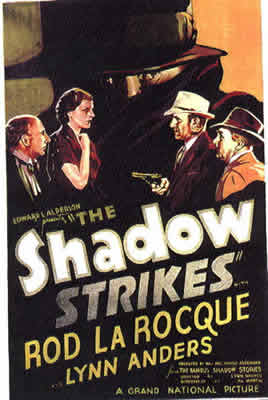 The Shadow was so popular they made a series of movies about the character. For some reason they never turned him invisible. He was just a silly looking guy in a hat that was too big for him and long black cape that he almost tripped over. Why he didn’t turn invisible is anybody’s guess. Roll film, stop film, actor walks off set, start film, hey! He turned invisible!
The Shadow on film was played, I swear I am not making this up, by a guy named Rod LaRoque. A better porn name is difficult to find. “Rod LaRock.” I suppose Long Cockman comes close. And while we are on the subject of dirty-sounding names, the radio Margot Lane, The Shadow’s assisstant, was first played by Agnes Moorehead.
The movie Shadow is a very different character than the radio Shadow, and for a good reason. Like the comic books and strips, the movie Shadow is based on the pulp fiction version of the character. While an invisible man is perfect for radio, it is kind of boring to watch. In print, The Shadow was a man in a dark cloak and hat. He carried a pair of guns and often used them. There was no invisibility for him, this Shadow had to rely on a perfect skill of disguise. And this Shadow wasn’t even Lamont Cranston, he just pretended to be. Confused?
 There was a Lamont Cranston in the pulps and the Shadow did claim to be him but he wasn’t. It was a disguise. The real Cranston was a wealthy playboy. He was usually travelling around the world or away at some glamorous resort. His high-class connections were just what the shadow needed to open doors so while Cranston was away, The Shadow would assume his identity.
The real identity of the Shadow, and you didn’t hear it from me, was Kent Allard, a World War One Aviator.
In addition to the pulps there were many comic book versions of The Shadow, and one of the best was put out by DC in the 1970’s, written by the legendary Denny O’Neil and often illustrated by the equally legendary Michael William Kaluta. And since this was a DC comic, he even met Batman. In fact, Batman claimed it was The Shadow who influenced him to fight crime.

But this is a Saturday Comics installment so let’s tear ourselves away from the comics (which I have a complete set of, including those Batman issues) and look at the rarely seen newspaper strip.

These are pretty hard to find. The strip began in 1940 and ended just two years later when World War Two broke out and the strip’s creators were drafted. Examples are hard to find online but luckily I have my own collection.
Some years ago in the 80’s the strips were collected in comic book form. the paper they were printed on was cheap even by comic book standards and my issues are all very, very yellow, much worse than other comics from the same era. The pages were even printed crooked!
I can’t vouch that the strips are formatted the same way they were as originally printed. Compare the dimensions to the strip above and you’ll see why I have doubts. I am also afraid some panels, like the title panel in the strip above, have been removed totally. At any rate, the odds are you have not seen these strips so sit back and check out an OTR legend and comic strip rarity, The Shadow!


As a bonus, I’m including what may be the most famous single broadcast of OTR, the infamous War of the Worlds broadcast starring Orson Welles and The Mercury Theater.
Special and extreme thanks to Jim of Relic Radio for providing the War of the Worlds. Check out his site for tons of great- and free! radio shows.
More special and extreme thanks to Peter Church of the wonderful Radio’s Revenge podcast for finding the music that opened this page, The Shadow theme.


 Mr. Blog's Tepid Ride
Your Comments