Tag Archives: New York

A New York Minute (9)

2 Jan

January 2, 2011

Welcome to your New York Minute.

They say that you can find anyone anywhere at anytime in New York. And that may be true, because this week I’m broadcasting from the intersection of Rex Harrison and Allen Ginsburg. Well, so to speak.

Rex Harrison may be best known as Doctor Doolittle in the 1967 film- you guessed it- Doctor Doolittle.

Can we get a little Rex Harrison? That’s the stuff.

He was a wonderful actor. Noel Coward said he was “the best light comedy actor in the world—except for me.” Um, Noel Coward was talking about himself, not yours truly.

Rex Harrison died in 1986, leaving behind six wives (five of them exes, of course) two sons, and three step-sons. One of his sons, born to actress Lilli Palmer, was a bright lad named Carey.

Carey Harrison is the celebrated author of 35 stage plays and 16 novels. He has written for radio and television. Masterpiece Theater has dedicated 17 hours to his work. Among many other things, he is a book reviewer and a columnist. He has won numerous awards and is currently writing an opera.

And he was my English professor in Brooklyn College.

Now I have to be honest. When I was his student I knew nothing about any of that. I knew his father was a famous actor but that was as far as it went. Professor Harrison was, and presumably still is, a very nice man and a scholarly gentleman. I enjoyed his class, which was planned around the novel The Good Soldier by Ford Madox Ford. I recall coming up with an insight about some of the minor character’s names, which I realized were the names of lesser Knights of the Round Table. Despite probably having heard the same insight hundreds of times from hundreds of students, he made me feel as though I had really accomplished something, which I much later in my own career realized was a hallmark of a good teacher.

The class was small, about a dozen of us gathered around a large conference table in his office, which he used instead of a classroom. It was intimate. One thing I admired about him was his passion not for writing, but for curiosity. At one point in the novel a character drinks, I believe, a sloe gin fizz, though it might have been a mint julep. Any of you Ford Madox Ford nuts in the audience, write in and tell me which it was. Professor Harrison stopped us to ask us about the drink. None of us had ever had one. We knew it was an alcoholic beverage, and some of us knew what was in it, but that wasn’t good enough for him. He chastised us- in a kind way- for not knowing more. What did it taste like? How was it made? I suspect it was that level of passion and attention to detail that makes him such a successful man.

I took the class in the winter and he invited all of us to a holiday party at his home and one of my regrets is that I didn’t go. I was never much of a joiner, especially then, and the prospect of spending the night in the company of what were virtually strangers and my English teacher did not seem very inviting. But as I said, I had no idea who my professor was. Looking back, all the questions I could have asked, all the stories I could have heard, the potential valuable professional contact- Professor Harrison, if you listen to Flash Cast, and I’m sure you do, please, invite me back! And if any of his current students are listening, yo, hook me up, dudes!

But I did say I was broadcasting from the intersection of Harrison and Ginsburg.

Allen Ginsburg, as I hope most of you know, was one of the leading Beat Poets of the 1950’s. If you know nothing else of him, get out of the house and look up his poem “Howl.”

He was a poet, a hippie, and a postmodernist. He was a Buddhist, a protestor, and a professor. Yes, he too taught English at Brooklyn College.

I did not get to meet Professor Ginsburg, though I understand no one called him Professor. I took Professor Harrison’s class not long after Allen Ginsburg died. Professor Harrison brought us into the small and dingy English Department office they shared. It was nothing special. It was functional, painted with neutral, faded grey paint and stocked with slightly beat up and worn furniture like you’d find in a cheap walk-in clinic. From the surroundings you’d never guess two such distinguished men worked there, yet they did. Professor Harrison reverently pointed to Allen Ginsburg’s chair, which he never allowed anyone to sit in, and showed us Ginsburg’s plants, which Professor Harrison continued to water. And if you Ginsburg fans are wondering, the plants were ordinary ferns, not marijuana.

I can’t say that I appreciated any of that tale at the time, but now several years later and reading it back as I write, that’s a pretty good story. And where else could it happen but Brooklyn New York?


An audio version of this legend recently appeared in the amazing FlashPulp website. Check them out for awesomeness and goodies!
 

A New York Minute (8)

26 Dec

December 26, 2011

Welcome to your New York Minute.

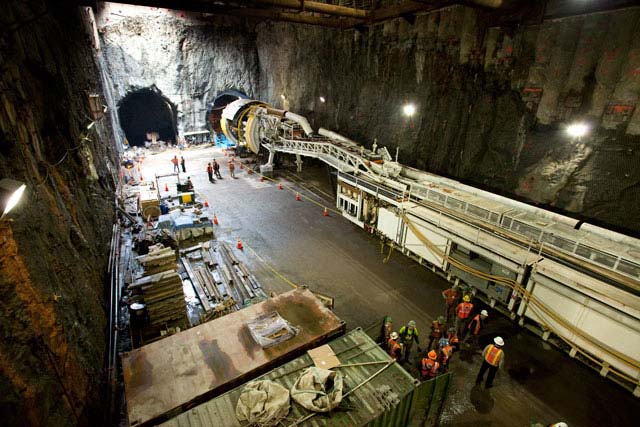
I’ve got progress on my mind this week, and in New York, progress can be agonizingly slow. Take the Second Avenue subway. It was first proposed in 1929 but only since 2006 has there been any progress.

But progress may not be all that it is cracked up to be. Here are some short quotes from a New York Times article from just a few years back.

Ah, the native sounds of a summer evening on the Upper East Side: hooting owls, honking cabs, chattering crickets. And, occasionally, the banshee-like shrieks of an air horn, followed by rumbling explosions that call to mind a Messerschmitt raid.

Nope, it’s not World War II — just the Second Avenue subway.

Residents along this cheerless East Side stretch have long wondered whether these late-night blasts are necessary for the construction of the new underground line, a 1.7-mile route that has been planned since the Great Depression.

And while the explosions may be deafening, the Metropolitan Transportation Authority now says it hears the public outcry loud and clear.

Starting on Monday, underground blasting will be banned after 7 p.m. along the Second   Avenue corridor, transit officials said. The moratorium, according to the transportation authority, was hashed out after discussions with local politicians and community leaders.

“People don’t want to have a romantic dinner with the sound of pavement being obliterated in the background,” said the project’s construction chief.

The project’s contract originally allowed for the blasts to continue until midnight, although Dr. Horodniceanu noted that the explosions usually stopped “after 9 p.m.”

That’s right. In the heart of one of the most populous parts of the most populous borough, the city was blasting the street apart with dynamite until midnight. You can imagine the disastrous effect the work had on the neighborhood. Hundreds of small businesses in the construction zone have closed, and that wasn’t even due to the blasting, it was due to the massive street closures and traffic disruptions which dropped foot traffic to near-zero.

But the story gets worse. Here are some excerpts from a New York Daily News article from earlier this week.

Blasting on the Second Ave. subway project was temporarily halted Tuesday amid a storm of complaints from upper East Siders about dust.

Long-suffering residents living with the constant tunneling are up in arms over the clouds of dust that appear during the underground explosions carving out what will be the 72nd St. station.

Community Board 8’s Second Avenue Subway Task Force Committee got an earful Tuesday night from 60 locals griping about pollution, noise and “the Second Ave. cough.”

Pressman said she went to her doctor after getting sick recently and was told, “‘You’ve got the Second Ave. cough!’”

Joan Schoenberger of E. 70th St. agreed that it’s become hard to breathe in her neighborhood.

“There’s a big smoke cloud,” Schoenberger said. “It’s very pervasive around that area.”

The audience packing the meeting at the New York Blood Center on E. 67th St. broke into applause when they were told blasting has been temporarily suspended until Dec. 5.

“We did that because we heard loud and clear from the community and elected officials, though it’s an impact to the construction schedule, and to workers,” said Bill Goodrich, the Metropolitan Transportation Authority’s senior vice president of capital construction.

Goodrich said the MTA will work on modifications to reduce dust, including revamping exhaust systems, over the next two weeks.

He wouldn’t say how many workers would be laid off, but he expects them all to be rehired when blasting resumes.

Assemblyman Micah Kellner (D-Manhattan) lamented the layoffs, but said, “We just can’t lived with Second Ave. being blanketed by dust each time they blast.”

“The MTA needs to insure our air quality,” Kellner said.

Tunneling for the first phase of the subway was finished in September. It will take five more years to build stations and lay tracks before the subway can open.

Yes, five more years. For a project that was considered a necessity even in 1929, completion in 2016 is ridiculous.

All of this put me in mind of the original subway construction early in the last century.

The following info was found online at generalcontractor.com

Ground was broken (for the subway) in March 1900 in Manhattan. The construction company chose shallow cut and cover as the excavation method to avoid having to tunnel deep under New York’s infrastructure. Wooden planking and bridges covered the construction so that traffic could continue over the tunneling that would go on for years.

The construction that was typical for the majority of the project was a flat roof I-beam construction with a concrete bottom. The side walls had I-beam columns five feet apart, with vertical concrete arches between the columns. The I-beams supported the masonry, allowing the walls to be built thinner than they could have been if concrete alone was used. The tops of the wall columns were connected by roof beams, supported by rows of steel columns between the tracks. They were built on concrete and cut stone bases. Because the tunnels were susceptible to water damage from the ground, several inches of felt washed with hot asphalt were laid behind the walls, over the roof and under the floor. In some places, this method of waterproofing was reinforced with one or two courses of brick. Terra cotta ducts for the electric cables were placed between the steel columns and waterproofing.

The station on 42nd Street between Park Avenue and Madison Avenue required a special method of construction. Five subway tracks passed through this area, and the excavation reached a depth of 35 feet and extended 15 feet into the rock. In order to construct this segment of the subway, a 30-foot wide trench had to be sunk on the south side of the street, in which the subway was built for the width of two tracks. At 50-foot intervals tunnels had to be driven toward the north side of the street, with tops four feet above the roof of the subway and bottoms on the roof. The ends of the tunnels were connected by a parallel tunnel just beyond the line of the fourth track. Workers were then able to excavate the rock in the bottom of the tunnels to their final depth. A bed of concrete was then placed in the parallel tunnel, and a third row of steel columns was erected in order to support the concrete and steel roof.

One hundred years ago the work was done without building-rattling midnight explosions and toxic dust clouds. Yes, it was hard work and manpower intensive, but it took great pains to minimize disruption to the city at large. For a project that even its biggest critics agree is a necessity but is still nowhere near completion, I have to wonder if the people in charge have any idea of what they are doing.

Stores going out of business, nightly blasting, and the air making people sick. This is progress?

This has been your New York Minute.

An audio version of this legend recently appeared in the amazing FlashPulp website. Check them out for awesomeness and goodies!