
July 11, 2011
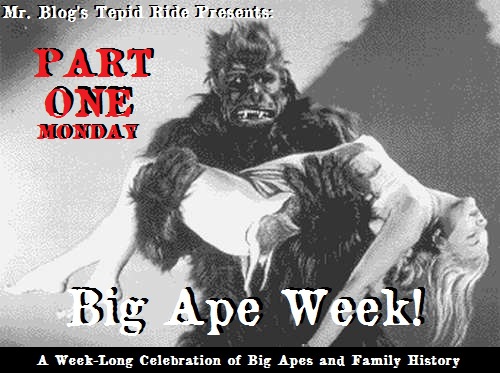
from July 1, 2007
My great-grandfather, back in the 1930’s had an idea. It wasn’t an original idea, no sir. Not by any stretch of the imagination. That wasn’t his style.
You see, Bradford B. Jacobs was President, Founder, and Chief Cinematographer of Jacobs Colossal Studios, a shabby and financially shaky movie production company based out of Patterson New Jersey. Bradford B, (it is he for whom I am named), did pretty well for himself in the silent film era. JCS was known for nature films and documentaries. At the height of the silent era, JCS cameras roamed the world to bring home the most thrilling nature footage ever seen. From Emperor Penguins of the South Pole to shaggy llamas of Tibet, there was no place on Earth not lensed by a Jacobs camera. Most famously, he persuaded Harold Lloyd to cameo in a Borneo-filmed short featuring playful marsupials. Bradford also had a pretty profitable sideline making “exotic native features” available for private viewing, but the less said about that the better. Bradford accumulated a sizeable catalog of various shorts and features which he often sold for use as stock footage in longer “A” movies by various studios.
However, with the coming of the “talkie” era, Bradford B. Jacobs found himself without a market. No one would buy his soundless films, and few would see them when the wonders of sound were in the next theater. Jacobs Colossal Studios was forced to downsize, and Bradford fired most of his staff and sold most of his equipment. Throughout the 1930’s he limped along by making extremely low budget “B” and even “C” features starring Wolfie the Yiddish Hound. This was in the era of the ethnic comedy, and no one milked that market better than JCS. In one month alone, Wolfie starred in no fewer than 13 shorts, and had a cameo in two Stepin Fetchit films. There were few residents of the Lower East Side who had never seen a Wolfie short.
Sadly, the Wolfie product was barely enough to keep the creditors away. Bradford was looking for his next big animal star, and most of his ideas were not going to work. (Foremost among them was Seamus the Squirrel, an Irish immigrant rodent who loved potatoes.) Often, Bradford would take his camera and wander, almost aimlessly, just to see what might strike his fancy. This resulted in Bradford amassing perhaps the most comprehensive collection of chorus girl footage on the East Coast. One day he found himself in Times Square and was awed by the sight of a movie poster. Rushing inside, he watched the film that would forever change his fortunes: King Kong.
I now quote from his 1967 biography, I Did It, So Sue Me:
I couldn’t believe my eyes. There was this ape on the screen, a great big ape. And as I sat there I was moon-struck by two things. First, look at the tits on that Fay Wray. Second, this ape looks fake. I got all this real footage of real apes locked away in my vaults. This Kong fella, he don’t look none too real to me. Look at what he does. Climbs buildings. Eats trains. Bullshit! I got footage of real gorillas that make him look like a nancy-boy. My apes, they climb trees. They eat bananas. They fight each other. They throw their shit around. When did you ever see King Kong do that? My Big Ape, he threw his shit around in all three films I made in 1941!
Bradford B. Jacobs decided then and there that his company would produce its own big ape film that make King Kong look puny. Ingeniously called The Big Ape, Bradford’s film was shot on the cheap. Using most of his stock footage and cut in with real actors who always craned their necks to the sky, JCS marketed a film that promised to deliver “the thrills the 1937 theater-goers demand!”
On paper, it doesn’t sound like a good idea. The filmed characters would do all their acting with each other, but when it came time for them to be in the same scene as The Big Ape, the film would cut to stock footage. There was a lot of pointing off-screen. However, Bradford had a lot of faith in his production. He knew that King Kong had stirred something in the public and they were starved for more Ape films. He was determined that JCS would milk it for all it was worth.
The Big Ape was a smash hit. Maximillian Dubois was the male lead, and Doreen Vernon was the love interest, but it was the stock ape footage that really shined. Bradford was right when he reasoned that a real ape would look better. On the big screen his old nature footage looked lush and vibrant. It really made King Kong seem drab. It also helped that Doreen Vernon was instructed to go braless in the jungle river scene, and in fact wore only the filmiest of tops throughout.
Despite having a plot that was lifted nearly scene-for-scene from Kong (the ensuing legal battle would drag on until 1958) and dialogue that consisted of things like “Look at that Big Ape! He’s bigger than that Ape I saw last year in that other movie,” the Big Ape made more money than Bradford ever dreamt of. (And this was no mean feat, as I remember growing up hearing stories of how my great-grandfather dreamed of enough money to overthrow Castro.)
Again, I quote from I Did It, So Sue Me:
I knew this would be big. It had a great formula: rip off a good film, add a sexy blond (who later became ex-wife number three) and give the public Big Ape action. Kong ate a train? My Ape ate an Edsel factory. Kong fought airplanes? My Ape fought 92 airplanes. Kong had Carl Denham, my film had a Teddy Roosevelt impersonator. It couldn’t miss!
It didn’t miss. In fact, it was the biggest money maker of the decade. Bradford B. Jacobs had more money than he ever had. First, he decided that it would be a good idea to buy his own zeppelin. Then he put on his payroll anyone whom he thought might be fun to have around. Sure, he had 237 people on his personal payroll, and another 43 who worked at the movie studio, but it didn’t matter because the money was rolling in and he was hard at work on the first sequel to The Big Ape, The Son of The Big Ape. Just one problem- he had used all the gorilla footage he had in the first film.
Bob “Bobo” Bigguns, interviewed by Barbara Walters in 1973:
Da Boss had hit into a fortune with that flick. Da public was bonkers ’bout dat Ape. Mr. J, he was walkin’ ’round with a solid gold fedora on his head an a four or five thousand dollar pair of socks on his feet. He never did wear no shoes. The trouble was that he used all of da gorilla and monkey footage in dat first film and had nothin’ left for the next. Well, lucky for Da Boss, I owned one of the best gorilla suits in West Hollywood at the time. I had a little act outside of da Hollywood Bowl that made me a few bucks on the weekends. Dat was when Mr. J hired me. He liked the way I swung from the lamp posts. Dat Mr. J, he was always hangin’ ’round with colorful people.
Not only did Bradford B. Jacobs have the best gorilla impersonator in L.A., he also hired a team of people to take care of the suit. Before filming even started, he had hired two men to comb the fur, a man to shampoo the fur, and two women to blow dry the fur.
Later that month, alighting from his Zeppelin, “The Jacobs Zephyr,” Mr. Jacobs made this announcement to the crowd gathered at Forbes Field: “Folks, there’s a new Big Ape film coming out soon. See it!” He then turned around and took off. While the announcement might not have set the crowd abuzz, they certainly became excited when Bradford began tossing silver dollars from his zeppelin.
Son of The Big Ape was released the following month. Variety ran the headline “Big Ape Boffo in Great Lake” above a story about the film selling out the Michigan Ave. Cinema for thirteen straight weeks.
Despite being billed as Son of, this was clearly meant to be the same ape. This film began just as the first one ended. Laying on the cement after falling to his death, the Big Ape simply stood up, dusted himself off, and ate some police officers. This film, freed of needing to cut away for stock footage, had the ape leaving New York and swimming (yes, swimming) to Cleveland to destroy another city. Bradford choose to film in Cleveland because it was cheap. It was in this film that, in a scene thankfully deleted by the film censor board, Bradford tried to live up to his pledge of having the Big Ape throw feces.
Audiences again went wild and Bradford made so much money that he gave it away to anyone who would do a funny dance for him.
Big Ape fever went so wild that these next films were all released by Jacobs Colossal Studios over the next three years. Shockingly, they all made money:
- The Big Ape vs. Giganto the Super Dinosaur
- Island of the Big Ape
- The Big Ape Escapes
- The Big Ape Meets Dracula
- Death to The Big Ape!
- The Big Ape Takes a Wife
- The Big Ape Goes to Washington
- The Big Ape vs. Nazi Ape
Around this time, the public, which loved both The Big Ape and its oddball creator, began to wonder why the quality of the films was starting to drop. Internally, many suspected it had to do with the fact that JCS had rushed out ten films in a four year span. Even the suit was beginning to look ratty.
Bradford B. Jacobs had also become a little, shall we say, eccentric. It became clear that he loved being rich. He wore a tuxedo wherever he went. If he had to drive, it was in a car which he claimed he won from FDR in a poker game. If he had to fly, he did it in a zeppelin. If he had to walk, he didn’t. He spent money as fast as he made it, which wasn’t a problem since the Big Ape films were guaranteed many makers. Famously, he once bought the Brooklyn Bridge and was later forced to sell it back to New York City. At a profit.
But as much fun as he had being rich, he was as bored making the Big Ape movies. After ten films, he sold the rights to the Big Ape to another studio, Maxwell Picture Corporation, headed by Luther Maxwell. Bradford B. Jacobs would never make another Big Ape movie.
For the first time. Jacobs was not the creative voice behind The Ape.
However, Luther Maxwell wasn’t alone with the franchise. Unbeknownst to him, Bradford also sold the rights to MGM, Paramount, RKO, Cinescope, Tohoscope, Artes D’France, and, without exception, every major or minor movie company in the world.
The lawsuit would drag on for decades but in the meantime, every one of those companies made Big Ape movies, television shows, cartoons, puppet shows, etc.
Film critic Jeffrey Lane:
You’d logically expect this flood on the market to lead to the end of The Big Ape, but such was the love for that character that every single thing made money. Meanwhile, Bradford B. Jacobs was fast becoming a fixture on the national scene. It didn’t matter to him that the quality of the Big Ape films ranged from genius (1963’s romantic Passions of The Big Ape) to moronic (1951’s Satan’s Sadists vs. The Big Ape.) From Christmas specials to political thrillers, there was not a genre untouched by the Big Apes furry paws.
TO BE CONTINUED IN PART TWO: THE BIG APE RISES TO GLORY




Your Comments