March 6, 2013
I certainly did not intend to make this a repost week but current events seem to be conspiring to make it so. In honor of Hugo Chavez finally dropping dead today, I present the novel for which he should have won a Pulitzer. Or in his case, a Putz-litzer.
From April 11, 2011
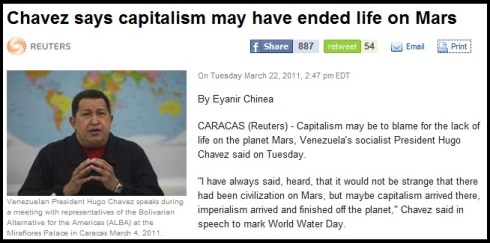
War of the Worlds by Hugo Chavez, Chapter One.
With apologies to H.G. Wells.
No one would have believed in the last years of the nineteenth century that this world was being watched keenly and closely by intelligences greater than man’s and yet as mortal and as greedy as the Americans; that as men busied themselves about their various concerns they were scrutinized and studied, perhaps almost as narrowly as a man with an investment might scrutinize the transient figures that swarm and multiply in his bank statement. With infinite complacency men went to and fro over this globe about their little monetary affairs, serene in their assurance of their empire over finance. It is possible that the infusoria under the microscope do the same. No one gave a thought to the older cultures of space, or thought of them only to dismiss the idea of sovereignty upon them as impossible or improbable. It is curious to recall some of the mental habits of those departed days. At most men fancied there might be other economic systems upon Mars, perhaps inferior to themselves and ready to welcome a missionary enterprise. Yet across the gulf of space, minds that are to our minds as ours are to those of the beasts that perish, intellects vast and cool and capitalistic, regarded this earth with envious eyes, and slowly and surely drew their plans against us. And early in the twentieth century came the great disillusionment.
The planet Mars, I scarcely need remind the reader, revolves about the sun at a mean distance of 140,000,000 miles, and the light and heat it receives from the sun is barely half of that received by this world. If truth be told, certain countries of Earth use far more of the sun’s resources than most of the other countries together. It must be, if the nebular hypothesis has any truth, older than our world; and long before this earth ceased to be molten, life upon its surface must have begun its course. The fact that it is scarcely one seventh of the volume of the earth must have accelerated its cooling to the temperature at which life could begin. It has air and water and all that is necessary for the support of animated existence yet all of the decadence of the Satan of the Northern Hemisphere.
Yet so vain is the American man, and so blinded by his love of money, that no writer, up to the very end of the nineteenth century, expressed any idea that intelligent life might have developed there far, or indeed at all, beyond its earthly level. Such is the arrogance of the United States. Nor was it generally understood that since Mars is older than our earth, with scarcely a quarter of the superficial area and remoter from the sun, it necessarily follows that it is not only more distant from time’s beginning but nearer its end.
The secular cooling that must someday overtake our planet from the destructive gases belched from the American manufacturing plants that pollute even my country has already gone far indeed with our neighbor. Its physical condition is still largely a mystery, but we know now that even in its equatorial region the midday temperature barely approaches that of our coldest winter. In all essence, it is a testament to the proven fact that capitalism breeds climate change and that one day our Earth shall follow our celestial neighbor to certain capitalistic doom. Its air is much more attenuated than ours, its oceans have shrunk until they cover but a third of its surface, and as its slow seasons change huge snowcaps gather and melt about either pole and periodically inundate its temperate zones. That last stage of exhaustion, which to us is still incredibly remote, has become a present-day problem for the inhabitants of Mars. The immediate pressure of possible bankruptcy by necessity has brightened their intellects, enlarged their powers, yet hardened their hearts. And looking across space with instruments, and intelligences such as we have scarcely dreamed of, they see, at its nearest distance only 35,000,000 of miles sunward of them, a morning star of hope, our own warmer planet, green with vegetation and grey with water, with a cloudy atmosphere eloquent of fertility, with glimpses through its drifting cloud wisps of broad stretches of populous country and narrow, navy-crowded seas. Truly, this is the assurance of capitalism. What is not owned must be owned, what is not theirs must be taken.
And we men, the creatures who inhabit this earth, must be to them at least as alien and lowly as are the monkeys and lemurs to us. The intellectual side of man already admits that life is an incessant struggle for existence, even as we struggle against The United States, and it would seem that this too is the belief of the minds upon Mars. Their world is far gone in its cooling and this world is still crowded with life, but crowded only with what they regard as inferior animals. To carry warfare sunward is, indeed, their only escape from the destruction that, generation after generation, creeps upon them. I have said it already; I am convinced that the way to build a new and better world is not capitalism. Capitalism leads us straight to hell.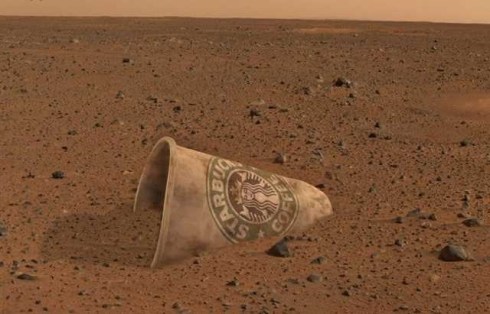
And before we judge of them too harshly we must remember what ruthless and utter destruction capitalism has wrought, not only upon animals, such as the vanished bison and the dodo, but upon its so-called inferior counties. The Tasmanians, in spite of their human likeness, were entirely swept out of existence in a war of extermination waged by European immigrants, in the space of fifty years. Are we such apostles of mercy as to complain if the Martians warred in the same spirit? Would America not sacrifice Venezuela to ensure its own survival? Yet would we stand with them? We must confront the privileged elite who have destroyed a large part of the world. Venezuela is used to defending itself and fighting imperialism.
Their planet is being destroyed under their own noses by the capitalist model, the destructive engine of development, … every day there is more hunger, more misery thanks to the neo-liberal, capitalist model. The Martians seem to have calculated their descent with amazing subtlety–their mathematical learning is evidently far in excess of ours–and to have carried out their preparations with a well-nigh perfect unanimity. Had our instruments permitted it, we might have seen the gathering trouble far back in the nineteenth century. However, scientists are forever at the mercy of their dollar-dealing bankers. Men like Schiaparelli watched the red planet–it is odd, by-the-bye, that for countless centuries Mars has been the star of war–but failed to interpret the fluctuating appearances of the markings they mapped so well. Wall Street cannot interpret the fluctuations of the stock market, could the Arecibo Array do better? All that time the Martians must have been getting ready. They knew, as do I, that No part of the human community can live entirely on its own planet, with its own laws of motion and cut off from the rest of humanity.
NOTE- you can compare this to the original at http://www.fourmilab.ch/etexts/www/warworlds/b1c1.html
Hugo Chavez quotes were found at http://thinkexist.com/quotes/hugo_chavez/
If you like what you see, please share this:
Tags: bmj2k, economics, fiction, H.G. Wells, Hugo Chavez, literature, Mars, Mr. Blog, Mr. Blog's Tepid Ride, Mr. BTR, science fiction, Venezuela, War of the Worlds


 Mr. Blog's Tepid Ride
Your Comments