Tag Archives: dinosaurs

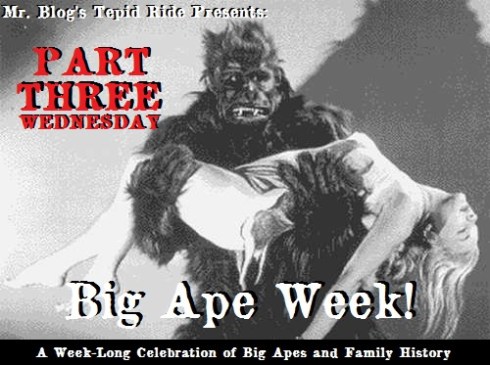
The Big Ape part three- The 1950s

13 Jul

July 13, 2011

from July 3, 2007

The 1950s in America were years of prosperity and paranoia. Rural life and racism. The post-war boom may have brought in an era of technology but it brought with it the Red Menace and McCarthyism.

Not surprisingly, The Big Ape fought them both.

The Big Ape Vs. The Red Menace (1954) was put out by All-American Films, which was actually owned by the Boy Scouts of America. In this one, The Big Ape, under presidential orders, infiltrated Moscow to show America the perils of communism. It was a smash, but of course all Big Ape films were smashes.

The Big Ape Vs. McCarthyism (1956) was a puppet show put on by protestors on the White House lawn.

1951 saw the release of the first of many Big Ape comedy albums. “Stop Me If You’ve Heard This One, Jerk” was an attempt by Bob Hope to dispel his good-guy image work with the raunchy jokes he loved. Hope had always harbored a secret desire to do dirty material, but working on the radio, and later TV and film, meant that he had to work clean and he did very well with his family-friendly act. In truth, Bob Hope was the nastiest man alive. Ask anyone who saw his Vegas lounge act. He knew, though, that releasing an album of dirty material would put an end to the gravy-train, so he decided to do it in the way guaranteed to make the most money while protecting his identity- he credited the album to The Big Ape and appeared on the cover wearing a tuxedo and gorilla mask. Only years after his death did the truth come out.

The comedy albums were but one type of record put out by The Big Ape. Motion picture soundtracks, original Broadway recordings, children’s songs, all were sung by The Big Ape. In 2005 the cast recording of West Side Story from 1959 featuring The Big Ape as Riff sold for $12,350, and a recording of him singing The Mikado went for $8,000. Even an LP of him covering Beatles tunes from the early 70s sold for $850.

Another notable Big Ape fact is that John Wayne earned $195,000 to play the title role in The Big Ape Goes Ape (1959) Wayne had always loved the Ape and wanted to play the Ape at any cost. Any cost to the studio, that is. There was no way that the pairing of the biggest western star and the biggest simian star could be done for less than big star salary. Wayne’s ego didn’t end there. Although the role meant that he would be masked, and Wayne was well aware of that, he still wanted his face to bee seen in the film, forever associating, at least in his mind, The Big Ape and John Wayne. To accomplish this, a lengthy prologue was added to the film. Wayne played Professor John Ape who, in the opening minutes, worked hard on perfecting the potion that would allow him to, in his words “become a giant ape, Pilgrim.” It was never explained why he wanted to become a giant ape, but that’s what he wanted and that’s what he got. But it wasn’t enough for Wayne to be seen in the beginning of the film unmasked, he actually wanted to share some scenes with The Big Ape. It was calmly explained that it would be impossible- after all, he was The Big Ape. So John Wayne, displaying none of the calm and grace that would serve him well in countless feature films, threw a tantrum and threatened to quit. Desperate to keep him (Why they would bother is up for debate. Every Ape film made a fortune.) the producers came up with an ingenious device in which Wayne would also play The Big Ape’s conscience, thereby allowing him and the Ape to appear together via split screen.

Film critic Jeffrey Lane:

            To say that America was having a love-affair with The Big Ape was an understatement. Look at these facts:

 One: Leave it to Beaver, a show about a suburban family whose young son may or may not have been legally stupid guest-starred The Big Ape forty-seven times. Forty-seven!

 Two: The Big Ape co-hosted the Academy Awards twice, once with Audrey Hepburn and once with Marlon Brando, both of whom complained of being overshadowed by the Ape.

 Three: The Big Ape was voted the state symbol of both New York and Colorado. This is why New York is called the Big Ape-le.

           The simple truth is that The Ape was a bigger star than anyone had ever seen before.

“Bigger” was an understatement. In 1953 Rocco Movie Co. was determined to feature the biggest-sized Big Ape in any movie. In Planet Big Ape, The Big Ape was so big he was actually larger than the Earth, and when our planet was destroyed by atomic radiation humanity had to blast off into outer space and colonize The Big Ape.

Sure the plots were silly. Sure the acting was atrocious. Sure the scripts were often bizarre and often The Big Ape only received a few seconds of screen time. If it had The Big Ape’s furry mug it was a hit.

Because of this, in 1958, serious thought was given to drafting Bradford B. Jacobs into the presidential race.

Bradford B. Jacobs, as quoted in Time Magazine, April 25th, 1971:

            So I was coming home from a little trip abroad and I got a phone call from some state legislator, Buck somebody-or-other. (NOTE: This was Bradford’s controversial goodwill visit to North Korea.) Asked if I wanted to be President. I said hell no! You see, I couldn’t afford the pay cut. I was supporting a staff of literally hundreds, not to mention a few ex-wives by this time. Sure, I worth at least a few billion dollars, but do you know how fast I spent money? I once paid Marilyn Monroe $50,000 just to sing “Happy Birthday” to JFK. And they all thought she was sleeping with him. She was sleeping with me!

Bradford had a profile unmatched in American culture before or since.

While he didn’t run for office, he acted like he was. He would make appearances at sporting events to throw out the first pitch. He went around kissing babies (and, very often, their mothers.) He chartered a train and made whistle-stop tours of the country. Invariably, his message was the same: “Buy my stuff.”

Meanwhile, not everything with The Big Ape in it was poor quality. In this era, there were some true cinematic triumphs. Foreign cinema, especially, would make true art house films starring The Big Ape. (It should be noted that most of the time, there was very little mention of the actor beneath the mask. This infuriated Liberace, who portrayed The Big Ape as a young piano prodigy in 1959s Clefs, Keys, and The Big Ape.)

This is a partial list of famous actors who played The Big Ape in the 1950s, according to BigApeOnline.com:

  •  John Wayne
  • Audie Murphy
  • Elizabeth Taylor
  • Bob Denver
  • Cantiflas
  • Alfred Hitchcock
  • Phil Silvers
  • Milton Berle
  • Orson Welles
  • Lucille Ball

As the 1950s ended and America looked ahead to the 60s, America readied itself for an era of change. Two things would be a constant in the coming years: The Big Ape and Bradford B. Jacobs.

TO BE CONTINUED IN PART FOUR: THE BIG APE BECOMES GROOVY

Wasei Kingu Kongu tai Gojira

8 Jul

July 8, 2011

I have always loved monster movies, especially old ones. Big apes, giant dinosaurs, ants, I love them all. It is in my blood and if you check this site on Monday you’ll see what I mean.

King Kong and Godzilla are the top of my monster movie list. You’ll find Frankenstein and Dracula there as well, but it is the men in rubber suits, the Japanese Kaiju (“monster” or “strange beast”), as well as their cousins the giant apes, that I hold dear.

I’ve seen every one of those films a few times, most more than a few. I’ve lost count of how many times I’ve seen King Kong to the point that I won’t even estimate. Even the worst Godzilla film (Godzilla’s Revenge) I know backwards and forwards. There isn’t a Reptilicus or Konga that I don’t know.

So it came as a bit of a shock to me when I discovered that there were two King Kong films that I never even heard of, let alone saw. I can be forgiven for not seeing them because they are lost films, likely destroyed in the bombing of Japan during World War II, but how could I have never even heard of a pair of Japanese King Kong films that predate Godzilla by over a decade and a half?

Not much is known about King Kong Appears in Edo, from 1938. This was an unauthorized Kong film in which the giant ape attacks medieval Tokyo (Edo.) Little is known about the film other than what can be gleaned from the movie poster above. It apparently featured the monster fighting samurai. (WHY is this film lost?!) We do know that the man who created the original Godzilla suit (Fuminori Ohashi) worked on the King Kong suit and he claims that many special effects that later became standard in Kaiju films were created for this film. By “special effects” I am sure he means “rubber suits and cardboard cities.”

As amazing as I found all of that, I was more amazed to find that there was an even earlier Japanese King Kong film, Wasei Kingu Kongu. (That translates as Japanese King Kong. Seriously.) This one was a 1933 silent film. It must have been rushed because it was put out the same year as the original. All that seems to remain is a single still. It was released by the same company that distributed the original King Kong in Japan, but it was made without RKO’s permission.

This was only the beginning. Late night research about these movies led to the solution of another King Kong mystery, one that had always bothered me.

King Kong Escapes (1967) is a strange movie. Although like the lost Kong films it is Japanese, this one was authorized. It plays nothing like the American King Kong and Son of Kong, but very much like the Japanese Godzilla movies. However, it has nothing to do with the Japanese King Kong vs. Godzilla of 1962. Confused? This next bit won’t help.

The plot revolves around bad guy Doctor Who, who has nothing to do with the BBC time traveler. However, when you consider the close physical resemblance between this film’s Doctor Who and William Hartnell as Doctor Who, there has to be more to it than mere coincidence.

Plot-wise, Doctor Who is using a robot King Kong (Mechani-Kong) to mine “Element X” but the robot proves unable to function due to the element’s extreme radioactivity. At the same time, a submarine crew finds the real King Kong on an island fighting various rubbery monsters. Doctor Who hypnotizes Kong to work for him mining Element X, Kong gets free, battles Mechani-Kong, and (of course) climbs a tall tower and falls for a girl. If you guessed that Kong wins and goes back to his island, join the crowd.


I have always wondered why this film was so unlike every other Kong film I ever saw, even King Kong vs. Godzilla. After all, they were both made by Toho. I was extremely curious about the blatant William Hartnell rip-off. Well, as I looked into the lost films, I found out that this film was based on the American Rankin/Bass King Kong cartoon, The King Kong Show. As the clip below shows, this was a very strange version of King Kong (but not too far off from the 1978 Hanna-Barbera Godzilla cartoon, strangely enough.) Doctor Who was the bad guy on the show. This cartoon only produced 25 episodes, too short for syndication, so that explains why I never saw it. It finished airing a year before I was born. As you’ll see at the end of this post, the cartoon Doctor Who looked nothing at all like the movie version, strongly implying that the resemblance to the BBC character was intentional. There were two big screen versions of Doctor Who featuring Peter Cushing in 1965 and 1966, so if in 1967 it looked like there was another big screen Doctor Who adventure, would the producers of King Kong Escapes be upset if a few extra people bought tickets thinking they were going to see the TARDIS and Daleks? I doubt it.


So my research solved a King Kong mystery, but brought up even more King Kong/Godzilla connections that I never knew.

Before King Kong Escapes, there was supposed to have been yet another King Kong Toho movie. However, because Godzilla was hugely popular, the world never saw King Kong vs. Ebirah but instead watched Godzilla vs. The Sea Monster. Basically, that title tells you all you need to know about the film. (Eibrah is a giant lobster.) If you saw the film you may have noticed that Godzilla acts out of character. He shows interest in a woman, throws boulders instead of using his fiery breath, and draws strength from electricity. Out of character for Godzilla, those traits were all established for King Kong in King Kong vs. Godzilla. They did almost nothing to alter the script but change the names. (King Kong gaining strength from lightening was added to make him more of a match for Godzilla, who spent much of the film roasting Kong with his breath until Kong amped up.)


Godzilla has a history of pinch-hitting. I also found out that the monster was never meant to be in Godzilla vs. Megalon. That film devotes a lot of screen time to Jet Jaguar, a fairly typical Japanese robot. It was the winning creation of a fan contest and was going to be the star of Jet Jaguar vs. Megalon. However, it was felt, and probably correctly, that the film needed a little more star power so Godzilla was added, and with a second hero (Godzilla was a good guy around this time) came a second villain, Gigan. By the way, if you have never seen the Mystery Science Theater 3000 version of that film, I urge you to finish this blog and then look it up on YouTube. It is that good. In fact, do yourself and the economy a favor and buy the DVD. You’ll thank me.

If you are wondering where the King Kong connection is, check out the movie poster for the American release:

Could they be any more blatantly misleading?

So there you have it. A chance peek at a list of lost films at 4am led to a sleepless morning of looking up monster movie trivia. Par for the course, really. One last thing I discovered is that what went on behind the scenes of a Godzilla movie was often more interesting than what went on the screen, especially if you are watching Son of Godzilla or the mind-numbing Godzilla’s Revenge.

Before you go, here is a fantastic 1967 Japanese magazine illustration dealing with the King Kong cartoon and relating to King Kong Escapes. The bald guy is Doctor Who.