
January 30, 2012
Here’s your New York Minute. Go tell the neighbors.
New York has a lot of famous residents, from Donald Trump’s hair to the giant inflatable rat that unions put up outside of non-union construction sites, but the most famous one of all arrived in 1933 and still holds as place in our hearts. Of course I’m talking about the original Big Ape, King Kong.
We all know the story. Carl Denham, played by Robert Armstrong, traveled to Skull Island to make a movie but ended up bringing Kong back to New York, where the giant ape tore up some train tracks and wrecked some buildings, before finally climbing the Empire State Building where he fell to his death. And in true New York fashion, in the sequel Son of Kong Denham had to dodge about at thousand lawsuits.
The film was a hit and is considered a cinematic classic.
The 1976 version? Not so much.
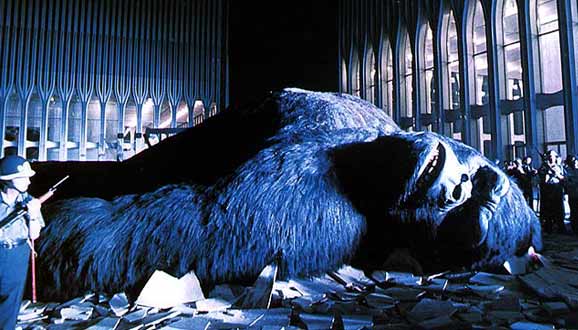
 In 1976 Dino DeLaurentis made a big-budget remake, which the movie poster somehow called “the most exciting original motion picture event of all time.” It kept the same basic plot but changed some key elements. Kong was found not by a movie producer but an oil company, but the biggest change was that Kong climbed the South Tower of the World Trade Center, which had beat the Empire State Building as the tallest building in Manhattan since the original movie came out.
The film got mixed reviews. Personally, I think it isn’t horrible on the one hand but not too good on the other. But it has one huge drawback. In most scenes, King Kong was played by a man in an ape suit. And it didn’t go over very well when Dino DeLaurentis put out an ad looking for, and I quote, “a well-built black man” to play the ape.
Even Rick Baker, a special effects man known for Hollywood makeup and said that the suit wasn’t at all convincing. And he should know, he wore it. However, they did make, and highly publicized, a 40 foot tall mechanical Kong. It cost 1.7 million dollars but didn’t convince anyone and it ended up appearing in just 15 seconds of footage. Yes, I said seconds. 1.7 million for 15 seconds. However, there were some other giant props, like Kong heads, hands, and arms, and that’s where I come in.
In 1976 my father had an office on the 15th floor of the South Tower of the World Trade Center, and his office overlooked the plaza where King Kong was being filmed. This was the World Trade Center’s first brush with heightened security. People who worked in the building had to have special passes. Certain parts were blocked off for filming. Notices warned everyone that they might be filmed as they went in or out of the building. Extra security and police had to be brought in to keep back the crowds who wanted to get a glimpse of the filming.
Although I was very young I have vague and fuzzy memories of looking down from Dad’s office and seeing some of the filming and especially some of the props. Most of the filming at the Trade Center was done at night but there were always things going happening on the set. And even though it was 35 years ago I’m pretty sure I’ll never forget looking down and seeing a giant ape being laid out in the plaza below the World Trade Center. Some things are unique, and in the age of CGI probably never to be repeated.
 Kong has been remade and reimagined over the years, from Peter Jackson’s overly long period piece to the Japanese-made battles with Godzilla and robo-Kong, but I’ll always think of King Kong as the giant gorilla who crushed Charles Grodin under his hairy foot.
 This has been your New York Big Ape Minute.
And that giant inflatable rat I mentioned? Here it is:

An audio version of this legend recently appeared in the amazing FlashPulp website. Check them out for awesomeness and goodies!


Your Comments