
January 23, 2012
This is your New York Minute. Number 12 in a series, collect them all.
We’re going to continue our river tour of New York City by going up the East River, which separates Manhattan and Brooklyn, and anchor right under the Brooklyn Bridge. Today I’ll give you a few of the lesser known but more interesting facts about what may be America’s most famous bridge.
 The opening of the bridge was officiated by not one but two incumbent New York Mayors. Brooklyn was an independent city when the bridge, which was originally called the New York and Brooklyn Bridge, opened in 1883 and wouldn’t consolidate with New York until 1898. The Mayors of both Brooklyn and New York, as well as President Chester A. Arthur, met in the center of the span.
The bridge took 13 years to build but it took only one week to inspire a panic. The bridge was designed with a long pedestrian path above the roadway and one day, as hundreds of people were walking across, a rumor, totally unfounded, spread that the bridge was about to collapse. People panicked, a stampede started, and when all was said and done, at least a dozen people were crushed and killed. Compare that to the great blackout of 2003 and the terror attacks of September 11th 2001. On both occasions, thousands upon thousands of people flooded across the bridge jammed almost shoulder to shoulder. There were no panics and no deaths on the bridge. I was lucky enough to be close to home, but my brother made that journey both times.
But back in 1883 people were afraid to cross the bridge. PT Barnum, showman, circus owner, and utterly shameless self-promoter, paraded 21 of his elephants across the bridge. The bridge was shown to be safe, and Barnum got a ton of free publicity. Leading the parade was Jumbo, and when he died his skeleton went back to New York as property of the American Museum of Natural History. And yes, that elephant’s name, which was a variation of a Swahili word, is where our word jumbo began.

The expression “taking a Brodie,” meaning a suicide jump, began on the Brooklyn Bridge. Steve Brodie, in 1886, may or may not have jumped from the Brooklyn Bridge. He wasn’t trying to kill himself; he just wanted to be famous and bragged about his upcoming jump. He even practiced by jumping from some smaller bridges. It is open to doubt if he ever actually jumped. The New York Times, which covered the event, claimed that he did, but other sources say that, even in 1886, it was a pretty open secret that an accomplice tossed a dummy off the bridge and Brodie simply hopped into the water off a boat so the captain could claim to rescue him. True or not, it didn’t stop him from opening a couple of successful saloons and starting a fairly successful vaudeville and movie career.
Selling the Brooklyn Bridge has also come into popular culture, as in the saying “if you believe that, I have a bridge to sell you.” In the early part of the 20th Century, George C. Parker did just that. In fact he did it twice a week, every week for years. He’d convince a gullible tourist of the value of controlling the major link between the boroughs and managed to make a nice living. Of course, he didn’t stop at just the bridge. The Statue of Liberty and pretty much every other major landmark was sold at one point or another. He had a large office and impressive looking- but fake- documents and was so successful that from time to time the police had to kick the “new owners” off the bridge and take down the toll booths they had built.
The Brooklyn Bridge undoubtedly still has some secrets left in her. In 2006, city workers discovered a forgotten Cold War era bunker built into the base of one of the Manhattan side supports. It contained supplies to survive a Soviet nuclear attack, including 352,000 cookies still sealed in their original tin cans.
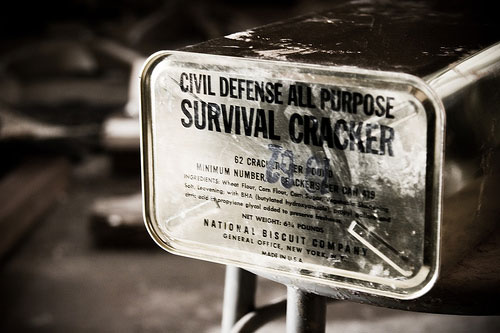
If you want to know more about Steve Brody and his jump, go to one of my favorite, and most reliable sources, Bugs Bunny. Surf over YouTube and search for the 1949 cartoon Bowery Bugs. It’s all about Steve Brody’s jump and the part Bugs Bunny’s played in it. Or just stick around to the end of this post.
Next week we’ll be crossing over the bridge and heading into Manhattan.
This has been your New York Minute.
An audio version of this legend recently appeared in the amazing FlashPulp website. Check them out for awesomeness and goodies!
 According to him, the idea for Radio’s Revenge started a couple of years ago with a desire to perform old-time radio scripts on stage for the entertainment of senior citizens. His principal duties around the podcast are as writer and actor. He’ll occasionally step in to help produce, edit and/or direct but those hats are more often worn by his creative partner, Sean Doyle. In other words, he’s taken something I’ve long wanted to do and actually made a go of it. I’m jealous, but on the other hand I am not nearly as talented.



 Mr. Blog's Tepid Ride
Your Comments