
December 12, 2011
Hello everyone, time for your New York Minute.
Nostalgia is a funny thing. No matter how good your life is or what state the world is in, it was always better some other time. Believe it or not, some day in the future someone will look back on his life and, with a wistful look in his eyes and the thin line of a tear drying on his check, say that he misses the good old days of 2011 when Occupy Wall Street violently clashed with the police, The Real Housewives were on every channel, and wonder why they don’t have great comedians like Russell Brand anymore. Trust me, wait and see. And yeah, another New York Minute and another shot at Russell Brand. He’s not funny.
A lot of people today are nostalgic for the 1970’s and I’m not sure why. New York was dirty, crime was way up, the subways were covered with graffiti, the city was broke, and every other day one union or another was going on strike. Even the 1970’s didn’t like the 1970’s, it was nostalgic for the 1950’s. Happy Days, Laverne and Shirley, American Graffiti, all were set in the 1950’s.
And so was The Lords of Flatbush.
Seriously, was the the worst trailer you have ever seen?
Released in 1974, it was the story of a gang of leather jacketed teenagers from Flatbush, Brooklyn. The teens, played by Perry King, age 26, Sylvester Stallone, age 28, and Henry Winkler, 29 years old, is a coming of age story starring three guys who came of age long ago. They steal cars, shoot pool, hang out, fight, and do all the things you’d expect a Hollywood version of a 1950’s gang to do. It is a good film, and some parts of it were actually shot in Brooklyn. The school scenes were filmed in Lincoln High School in Coney Island. I know that school very well, but that’s a New York Minute for another time.
The only problem with the movie is the totally misleading title. A bunch of greasers from the 50’s? Sorry, no. Ask anyone over a certain age and they’ll tell you that the real Lords of Flatbush were the Brooklyn Dodgers.
In baseball, the Brooklyn Dodgers have reached mythic proportions. Anyone who was a Brooklyn Dodgers fan in the 1950’s is a fan for life, despite the team’s moving to Los Angeles in 1958. Fans were passionate about the players, and even non-baseball fans will recognize some of the names, like Jackie Robinson, Pee Wee Reese, and Gil Hodges.
My mother and my uncle were Dodger fans growing up, and for some reason my grandfather was a New York Giants fan. It wasn’t like the Mets and Yankees rivalry today, baseball was personal then. The Dodgers were underdogs, they were Brooklyn guys, they were us and we were them. Not me, I wasn’t born yet, but you know what I mean. The Yankees were in the mix too and they had passionate fans but the Dodgers had a blue-collar working stiff image that people responded to. And they were local guys, from Flatbush. So my mom, my uncle, and grandpa were a tight-knit family but sitting around the table talking baseball was a different story. Dodgers fans and Giant fans did not mix. I have no idea how my family survived.
So the baseball debate raged in my family’s first floor apartment on King’s Highway and into the mix a real Brooklyn Dodger was added. Sandy Koufax briefly lived in my family’s building. Yes, my mom knew Sandy Koufax.
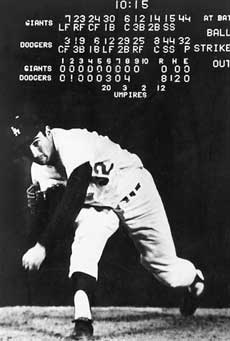 165 wins and only 87 losses, an ERA of 2.76, and 2,396 strikeouts. Inducted in 1972, Sandy Koufax is true Baseball Hall of Famer. He threw four no hitters, won three Cy Young awards, and was the league’s MVP in 1963.
Those of you who follow my blog know that I am a former teacher and I recently finished a nine-week series about my former life. I taught for ten years in a particular school and it happens to be the same school attended by Sandy Koufax when he was a rising high school baseball star. Even decades later it was still a big deal.
So my family has a six-degrees sort of connection to Sandy Koufax and yes he is a legend in the sport, and yes he famously refused to pitch the first game of the 1965 World Series because it fell on a Jewish holiday, and yes he is revered in baseball circles but again, nostalgia rears its head.
Great athletes do not great people make, and while I am not saying that Sandy Koufax is in any way a bad man, the facts are that when he was young and living in my mother’s apartment building he was, I don’t want to say rude, but he never spoke to any of his neighbors. I don’t mean he turned down autograph requests and refused to give free tickets to the games, I mean he never said hi when you passed him the halls. And decades later, when I sent him a personal appeal on behalf of my high school’s yearbook he never replied. But to be fair, neither did Larry King, who also attended that school.
And while I am name dropping, over the years the school I taught in was also attended by artist Peter Max, Sopranos actor Steven Schirripa, singer Vic Damone, sitcom creator Gary David Goldberg, Paul Sorvino, Rhea Perlman, and my father, among many other famous alumni.
Fred Wilpon, owner of the New York Mets attended that school. Say what you will about him and his team, but when we sent him a letter asking for a donation for the yearbook he actually sent us a donation. Most people never got back to us.
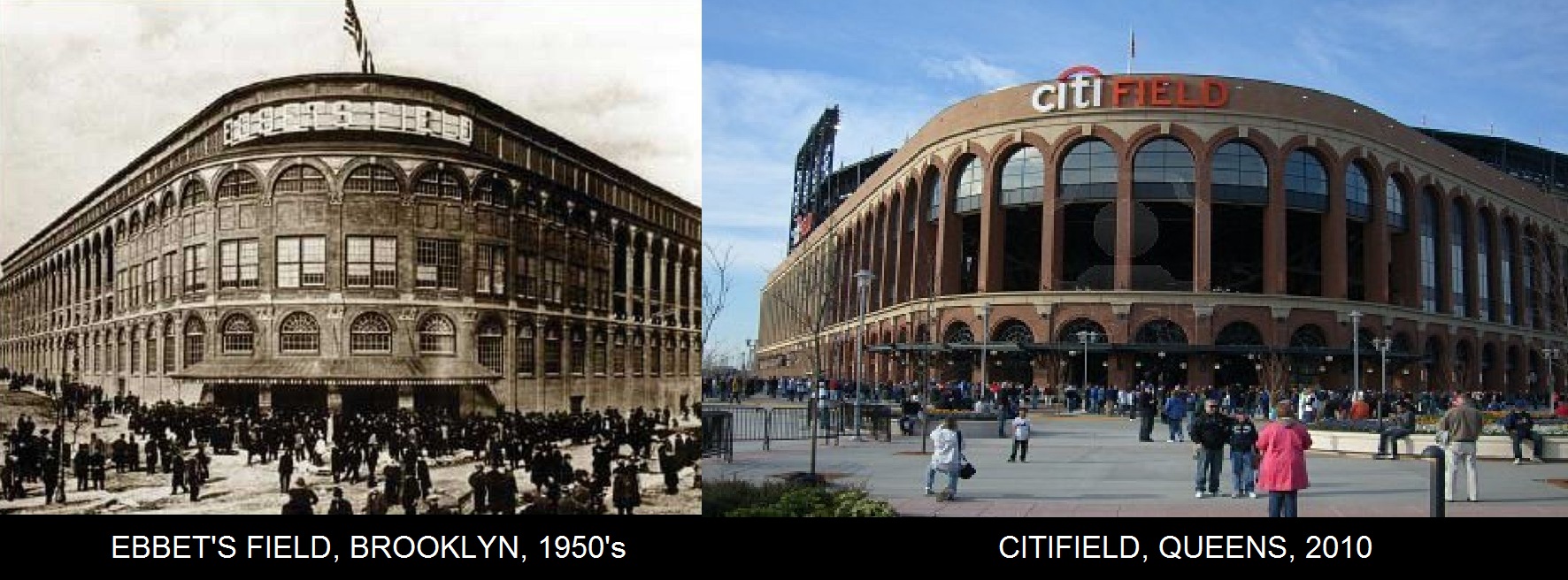 Today the legend of the Brooklyn Dodgers is carried on by the New York Mets. The blue in their uniforms is taken from Dodger blue and their new stadium is a replica of the Dodger’s old stadium, Ebbet’s Field.
Too bad they are such a lousy team. And before you complain, yes, I am a long-suffering Mets fan. And no Mets fan knows nostalgia like we do. Say “1986” to any Mets fan and you’ll get a reaction.
In a few years you may even be nostalgic for this New York Minute.
 According to him, the idea for Radio’s Revenge started a couple of years ago with a desire to perform old-time radio scripts on stage for the entertainment of senior citizens. His principal duties around the podcast are as writer and actor. He’ll occasionally step in to help produce, edit and/or direct but those hats are more often worn by his creative partner, Sean Doyle. In other words, he’s taken something I’ve long wanted to do and actually made a go of it. I’m jealous, but on the other hand I am not nearly as talented.



Your Comments