Archive | Culture RSS feed for this section

The Saturday Comics: What Were They Thinking?

10 Dec

December 10, 2011

Sometimes comic companies seem to lose their minds. You look at what they put out and you wonder who they expect to buy it. I’m not talking about a badly written story or an issue with bad art, I am talking about a comic whose very cover makes you think that just maybe the publisher has had a stroke. This week I present five WTF? covers and I am proud/sad to say that I own four of them.


There was a time that Batman was so popular that you could put anything on the newsstands and it would sell as long as it had Batman on the cover. Now while I am firmly of the opinion that everything is better with apes, this one leaves me scratching my head.

First of all, the ape is wearing a cowl, presumably to protect its identity. But Batman goes right ahead and blows it by blurting out his name. Way to go, Bruce.

Secondly, the gorilla must have ripped that flag pole out of its base on the roof, and I am just not sure gorillas are that strong. And really, did Batman and Robin have no other way of getting across the rooftops? Did they  forget their Batropes at home?

And finally, why? Why bother? Does Batman really need an ape sidekick?

But I have to be honest. If I were a kid I would have totally bought that issue.


Sticking with Big Apes (forgive me) we have this issue of Konga’s Revenge, based on the Ape from Konga which you may recall from The Late Night Movie House of Crap.

This is a comic book starring a giant rampaging ape. Did that not offer enough creative opportunities that the creators found it necessary to send him back in time too? Is Konga that much more exciting when facing a Trojan warrior? In my opinion, once you have a giant ape running amok, why mess with a good thing?

But to be fair, King Kong once had to face ancient warriors too.


I’ve covered Jimmy Olsen comics before and I am more convinced than ever that DC had no clue what to do with that book.


I must admit that not only do I own this book, I love it. It really is a lot of fun. But above all, you have to admire the sheer ego, gall, and chutzpah it took for Stan Lee and Jack Kirby to put themselves into the comic- and as the stars, no less!

The premise is that, on “our” Earth, the editors and staff of Marvel Comics received a mysterious package that turned them into the Fantastic Four. That’s Stan Lee as Mr. Fantastic, Jack Kirby as The Thing, Sol Brodsky as The Human Torch, and Flo Steinberg as The Invisible Woman. Admittedly, the Marvel bullpen was already legendary, and none more so than Stan and Jack, but to put themselves out there are comic book stars? Sheer hubris.
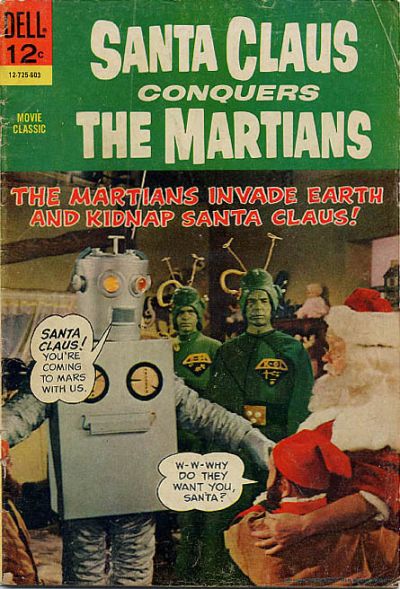
 

Honestly, I look at that cover and I cannot decide between “genius” and “crap.” And while I think I fall on the “crap” side of things, I’ve got to say that with a cover like that, how could that comic not sell?

On the other hand, the movie is utter, utter trash.

Spotlight: Peter Church and Radio’s Revenge

7 Dec

December 7, 2011

Meet the Renaissance Man, Peter Church. When I contacted him about being part of this spotlight week, I gave him carte blanche, as I did everyone. I didn’t know what I would get, but I knew it would be good. As you will read below, Peter Church (known in certain quarters as Jello Again!- and bonus points if you get the reference) is an actor. He appears on stage and video and lends his considerable vocal talents to performing original audio dramas for Radio’s Revenge.

Peter has spent the last six years as a repertory actor for The Classical Theatre Project (Toronto), logging thousands of performances in productions of Hamlet, Macbeth, Romeo & Juliet, Othello and A Midsummer Night’s Dream.

According to him, the idea for Radio’s Revenge started a couple of years ago with a desire to perform old-time radio scripts on stage for the entertainment of senior citizens. His principal duties around the podcast are as writer and actor. He’ll occasionally step in to help produce, edit and/or direct but those hats are more often worn by his creative partner, Sean Doyle. In other words, he’s taken something I’ve long wanted to do and actually made a go of it. I’m jealous, but on the other hand I am not nearly as talented.

Another one of the good guys, Peter has taken time out of his busy (and I mean that, the man is busy) schedule to give us the essay below. After reading it, I knew that this had to run today, December 7th: Pearl Harbor Day. While WWII is sometimes considered a high point in American patriotism and spirit, it also led to some awful propaganda and stereotyping. So while you recall the tragedy of the sinking of the USS Arizona and think about the soldiers from around the world who died in what was arguably the last great and just war, take a second out to think about what Peter has to say about our culture.

Find him online at www.twitter.com/radiosrevenge and look for him on Facebook here.

 Stereotypewriter.

The issue of racism, sexism, and other cultural insensitivities in vintage entertainment is nothing new.  I’m sure most of us have all heard of instances where a group of people wants to remove the N-word from “Huck Finn” or ban a Bugs Bunny cartoon made in 1941.

“Bugs Bunny Nips the Nips,” 1944, removed from circulation by Warner Brothers. Copies of the Looney Tunes Golden Collection containing this cartoon were recalled and replaced with another cartoon after a very small number of complaints.

I’ve often engaged in this debate and it seems to me that most reasonable people hold a rather moderate position on the subject.  People that appreciate the importance of Art don’t seem to want to sanitize our History.  Likewise, most people who understand History do not seem to want to censor its Art.  I suppose Art and History are actually two sides of the same coin since, at some point, Art actually becomes a way of recording History.

An example of this came a couple of years ago when I was attending the Silent Comedy Short-Film Festival in Toronto, Ontario, Canada.  The curator started by describing some racist content in one of the upcoming shorts from the 1920’s, where a white guy spills molasses on himself and is mistaken as a black guy, and a black guy gets flour on himself and is mistaken as a white guy.  He went on to explain that he was having second thoughts about sharing it as part of the festival and wanted the audience’s opinion on the subject.  The audience (about 200 people) unanimously voted for the film to be presented as originally planned.  At the end of the screening, during a talkback session, the consensus seemed to be that it would be irresponsible NOT to revisit offensive material from our past.  How else can we learn from our mistakes?  If we hide our past, or pretend that it’s blemish-free, then we start to re-write our history and can’t properly or honestly build our future.

Woof, woof, woof.

What I’m wondering now is – what does all this mean for someone like me – someone who creates modern comedy based on, or inspired by, vintage entertainment?  In my case, I write and produce radio plays in the setting and style of broadcasts from the 1930’s, 40’s, and 50’s.  The scripts are light and fun and need to be suitable for airing on a small-town radio station.  Of course, like the short-film described above, our source material include racial and gender stereotypes that can be abrasive to modern sensibilities.  Here are just a few arbitrary examples:

Radio is a faceless medium and therefore the audience has very little context for who we are or what we do.  As a modern writer, who presumably knows better, do I have a social responsibility to let bygones remain as bygones?  When we live in a culture that regularly produces “shock jocks” and “gross-out comedies”, where is the line between poking fun at nostalgic conventions and simply enflaming current sensitivities?

As an unofficial centre of American Art & History, I’d love to hear answers.  Please post a comment and let me know what you think.

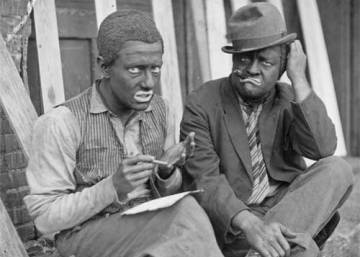
Radio’s Amos and Andy