
September 10, 2011
Ben Casey was a TV medical drama that ran from 1961 to 1966. It was one of the most popular shows of the time and was referenced or parodied everywhere from popular music (“Callin’ Dr. Casey” by John D. Loudermilk) to The Flintstones. (“Monster Fred” from season five with Doctor Len Frankenstone, who switched Fred’s brain for Dino’s. Gotta love The Flintstones.)
When I was young I saw a couple of episodes and today it is, as far as I can tell, not broadcast anywhere. It is just another old TV show. But this is The Saturday Comics, not The Saturday Old TV Shows. So why am I talking about Ben Casey?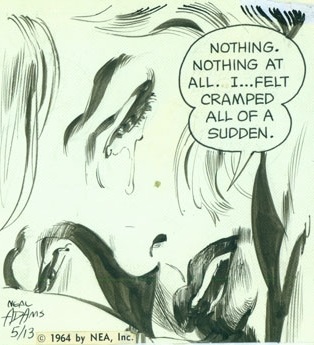
That’s why.
That’s a great piece of Neal Adams art, and he did it daily on the Ben Casey comic strip.
If you don’t know Neal Adams, feel free to turn in your pop culture badge now and walk away.
Some bits of his wikipedia bio:
Neal Adams is an American comic book and commercial artist known for helping to create some of the definitive modern imagery of the DC Comics characters Superman, Batman, and Green Arrow; as the co-founder of the graphic design studio Continuity Associates; and as a creators-rights advocate who helped secure a pension and recognition for Superman creators Jerry Siegel and Joe Shuster.
Adams was inducted into the Eisner Award’s Will Eisner Comic Book Hall of Fame in 1998, and the Harvey Awards’ Jack Kirby Hall of Fame in 1999.
Green Lantern/Green Arrow and “relevant comics”
Continuing to work for DC Comics during this sojourn, while also contributing the occasional story to Warren Publishing’s black-and-white horror-comics magazines (including the Don Glut-scripted “Goddess from the Sea” in Vampirella #1, Sept. 1969), Adams had his first collaboration on Batman with writer Dennis O’Neil. The duo would later revitalize the character with a series of noteworthy stories reestablishing Batman’s dark, brooding nature and taking the books away from the campy look and feel of the 1966-68 ABC TV series. For now, however, they would do only two stories, “The Secret of the Waiting Graves” in Detective Comics #395 (Jan. 1970) and “Paint a Picture of Peril” in issue #397 (March 1970), with a short Batman backup story, written by Mike Friedrich, coming in-between, in Batman #219 (Feb. 1970). Batman’s enduring makeover would come later, after Adams and O’Neil’s celebrated and, for the time, controversial revamping of the longstanding DC characters Green Lantern and Green Arrow.
Rechristening Green Lantern vol. 2 as Green Lantern/Green Arrow with issue #76 (April 1970), O’Neil and Adams teamed these two very different superheroes in a long story arc in which the characters undertook a social-commentary journey across America. A major exemplar of what the industry and the public at the time called “relevant comics”, the landmark run began with the 23-page story “No Evil Shall Escape My Sight” and continued to ” …And through Him Save a World” in the series’ finale, #89 (May 1972). Wrote historian Ron Goulart. These angry issues deal with racism, overpopulation, pollution, and drug addiction.
Here is a sample of his amazing Batman covers, featuring issues from my own collection.
He didn’t take the easy way out with Ben Casey either.
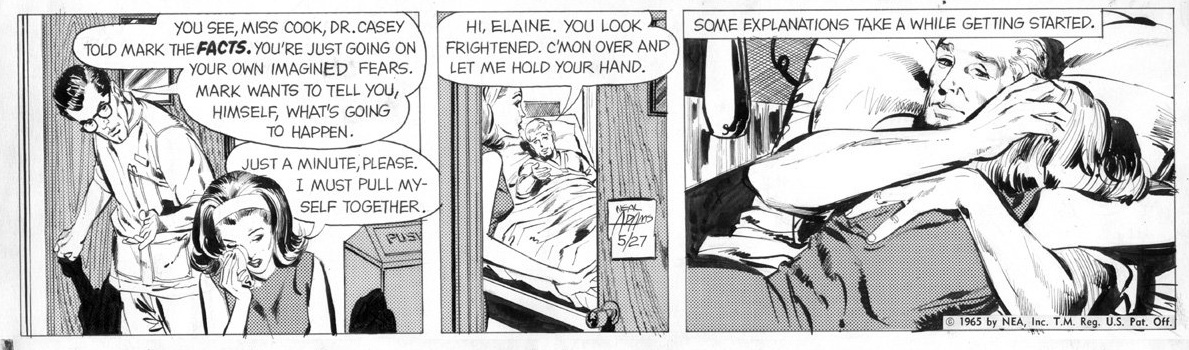
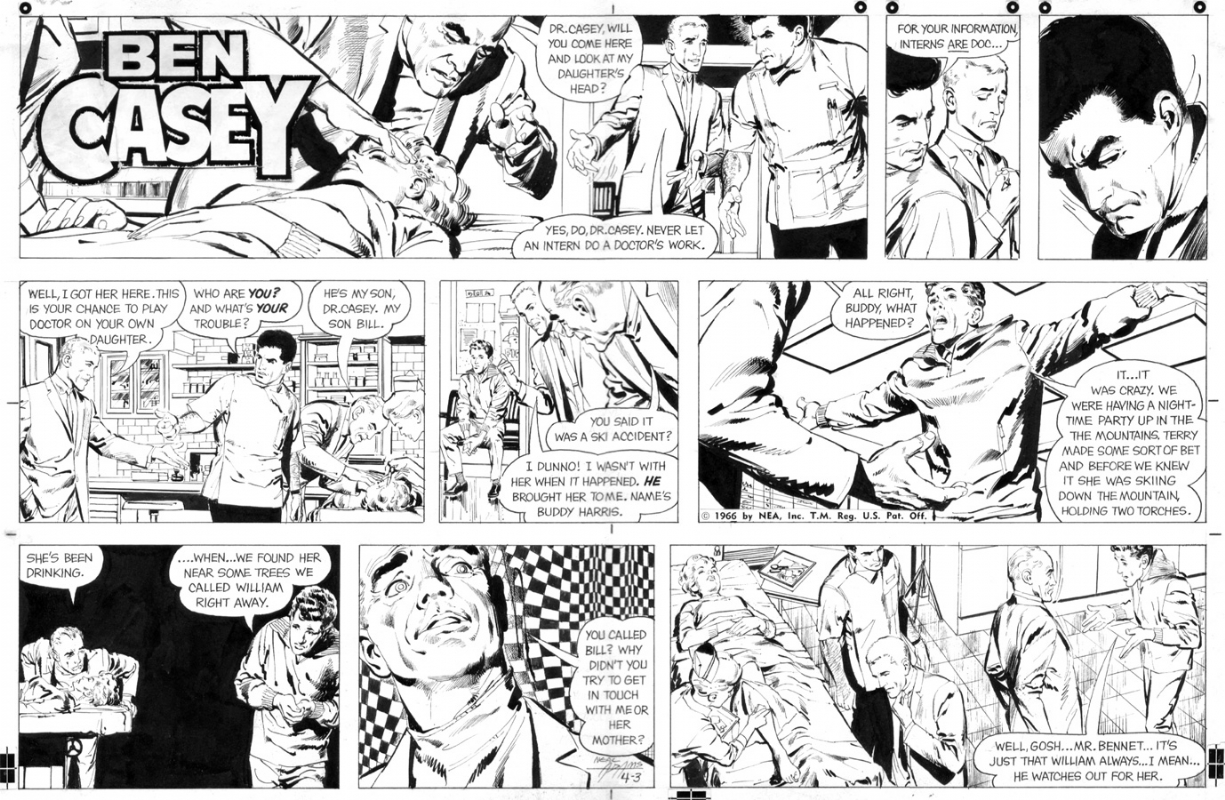
Comics historian Maurice Horn said the strip “did not shrink from tackling controversial problems, such as heroin addiction, illegitimate pregnancy, and attempted suicide. These were usually treated in soap opera fashion … but there was also a touch of toughness to the proceedings, well rendered by Adams in a forceful, direct style that exuded realism and tension and accorded well with the overall tone of the strip”.
So feast on Neal Adams’ craft on the Ben Casey strip, a craft which is almost too good for a daily newspaper comic.




 Mr. Blog's Tepid Ride
Your Comments