Tag Archives: Politics

The Big Ape part four- The 1960s

14 Jul

July 14, 2011

from July 6, 2007

1963 was the year that The Big Ape’s Banana Chew went on the market. This was “the gum that makes you go Ape!” Bradford B. Jacobs had acquired a Korean bamboo factory in some shady dealing that he paid the government a lot of money not to look into. He converted it into a gum factory and, despite the gum tasting not a bit like banana and quite a bit like bamboo, quickly expanded into two, then three then twelve factories.

During the Korean War Bradford made a few investments in Korea, betting on a quick victory.

Historian Arnold C. Didikoff:

           It didn’t come out until the 1990s, but it turned out that Mr. Jacobs had invested quite heavily in the Korean War effort. The North Korean effort, that is. Despite being a self-proclaimed patriot and after claiming for years that he was a direct descendant of Martha Washington, Mr. Jacobs pumped a lot of money into the North Korean economy.

 (Perhaps this explains the present he gave me on my first birthday: a Kim Jong Il teddy bear.)

           But it must be stressed that Mr. Jacobs was not anti-American, he was pro-making money wherever he thought he could.

 Big Ape Banana Chew was followed by many more candy products by Bradco Confectionary Industries, as Bradford’s candy-making company was dubbed. Chocolate Big Ape paws,  Mint Ape Bits, and his biggest seller, Furry Cocoanut Big Ape Balls all debuted in short order.

Bradford, by 1965 wanted to move into gourmet food. Thus, Big Ape bouillabaisse, Big Ape truffles, Big Ape steak tartar, and Big Ape fugu all were featured on the menu of Bradford’s Big Ape Steak House, a chain of 198 restaurants all across the eastern seaboard.

What follows is a partial list of  Big Ape products, services, and locations owned or produced by Bradford B. Jacobs in 1968:

  • Big Ape service stations, featuring Bradco Fuel
  • Big Ape Margarita Mix
  • Big Ape crossword puzzle books
  • Big Ape colostomy bags
  • Big Ape dishwashing liquid
  • Big Ape Light Menthol Smokes (non-toxic)
  • Big Ape Light Menthol Smokes (toxic)
  • Mrs. Big Ape Tupperware

1968 also saw the first significant addition to the Big Ape world in decades: Li’l Big Ape. MGM released Son of The Big Ape Part Two, a sequel to Son of The Big Ape.

This does not feature the same son. Tragically, The Big Ape’s first born died in 1956 while rescuing Napoleon from a volcano in a time-travel epic. This Ape-son was much cuter, much smaller, and much easier to market. Dubbed The Li’l Big Ape, this new simian smash would rival his father in the sheer amount of products produced bearing his image. This new character was aimed squarely at the toddler set, and no baby would be seen in public without The Li’l Big Ape on the back of his diaper.

In the 1960s, The Big Ape would change with the times, sometimes radically, sometimes from film to film.

1961- Big Apes on the Moon pre-dated the moon landing by several years. In this film, The Big Ape was the first Mexican astronaut sent to the moon.

1962- The Big Ape Meets El Presidente pitted The Big Ape against Castro.

1962- The Big Ape Defeats the Imperialists pitted a Cuban Big Ape against American forces in Havana.

1969- The Big Ape Steps on Hippies is self-explanatory.

1969 was also the year that Alfred Hitchcock (yes, that Hitchcock) remade his classic film Vertigo as Big Ape Vertigo, a faithful remake featuring Cary Grant as The Big Ape.

Shortly before his death, Alfred Hitchcock mused on his contribution to The Big Ape legacy:

          Well, you see, everyone just had to make one. No director worth his salt could lay a claim to greatness without at least one Big Ape epic to his name. The question, really, has been why I choose to remake Vertigo. Simply put, I had always viewed that as a flawed film. Despite a cast of talented stars, and a script worthy of them, I had always harbored a secret desire to remake it with The Big Ape. On retrospect, I should simply have made it with The Ape the first time.

Famous directors all made Big Ape films:

  • John Ford- Big Ape High Noon
  • Sergio Leone- The Good, The Bad, and The Big Ape
  • Inishiro Honda- The Big Ape Vs. Godzilla
  • Cecil B. DeMille- The Ten Big Ape Commandments
  • Elia Kazan- Cat On a Hot Tin Big Ape Roof
  • Mel Brooks- The Big Ape Producers

There were novels, stage plays, television dramas, and products available everywhere featuring The Big Ape. Bradford B. Jacobs continued to make fortunes unimaginable. He bought houses in all major cities, tried to buy major cities, and became a star himself with his weekly commentary “These Things I Believe” every Wednesday on the CBS Evening News.

Bradford had a minor health scare when an actor in a Big Ape suit attempted to climb a flagpole for Bradford’s birthday. The actor’s Big Ape paws didn’t grip the pole very well and he fell on Bradford, breaking the entrepreneur’s left arm. Major networks broke into their regular programming to cover this story. It was after this event that Big Ape first-aid kits hit the market.

Obviously, everything Bradford B. Jacobs touched turned to gold. Furry Big Ape gold.

TO BE CONTINUED IN PART FIVE- NIXON MEETS THE BIG APE, THE 1970s.
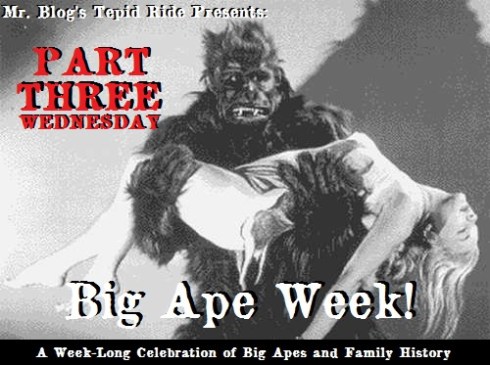
The Big Ape part three- The 1950s

13 Jul

July 13, 2011

from July 3, 2007

The 1950s in America were years of prosperity and paranoia. Rural life and racism. The post-war boom may have brought in an era of technology but it brought with it the Red Menace and McCarthyism.

Not surprisingly, The Big Ape fought them both.

The Big Ape Vs. The Red Menace (1954) was put out by All-American Films, which was actually owned by the Boy Scouts of America. In this one, The Big Ape, under presidential orders, infiltrated Moscow to show America the perils of communism. It was a smash, but of course all Big Ape films were smashes.

The Big Ape Vs. McCarthyism (1956) was a puppet show put on by protestors on the White House lawn.

1951 saw the release of the first of many Big Ape comedy albums. “Stop Me If You’ve Heard This One, Jerk” was an attempt by Bob Hope to dispel his good-guy image work with the raunchy jokes he loved. Hope had always harbored a secret desire to do dirty material, but working on the radio, and later TV and film, meant that he had to work clean and he did very well with his family-friendly act. In truth, Bob Hope was the nastiest man alive. Ask anyone who saw his Vegas lounge act. He knew, though, that releasing an album of dirty material would put an end to the gravy-train, so he decided to do it in the way guaranteed to make the most money while protecting his identity- he credited the album to The Big Ape and appeared on the cover wearing a tuxedo and gorilla mask. Only years after his death did the truth come out.

The comedy albums were but one type of record put out by The Big Ape. Motion picture soundtracks, original Broadway recordings, children’s songs, all were sung by The Big Ape. In 2005 the cast recording of West Side Story from 1959 featuring The Big Ape as Riff sold for $12,350, and a recording of him singing The Mikado went for $8,000. Even an LP of him covering Beatles tunes from the early 70s sold for $850.

Another notable Big Ape fact is that John Wayne earned $195,000 to play the title role in The Big Ape Goes Ape (1959) Wayne had always loved the Ape and wanted to play the Ape at any cost. Any cost to the studio, that is. There was no way that the pairing of the biggest western star and the biggest simian star could be done for less than big star salary. Wayne’s ego didn’t end there. Although the role meant that he would be masked, and Wayne was well aware of that, he still wanted his face to bee seen in the film, forever associating, at least in his mind, The Big Ape and John Wayne. To accomplish this, a lengthy prologue was added to the film. Wayne played Professor John Ape who, in the opening minutes, worked hard on perfecting the potion that would allow him to, in his words “become a giant ape, Pilgrim.” It was never explained why he wanted to become a giant ape, but that’s what he wanted and that’s what he got. But it wasn’t enough for Wayne to be seen in the beginning of the film unmasked, he actually wanted to share some scenes with The Big Ape. It was calmly explained that it would be impossible- after all, he was The Big Ape. So John Wayne, displaying none of the calm and grace that would serve him well in countless feature films, threw a tantrum and threatened to quit. Desperate to keep him (Why they would bother is up for debate. Every Ape film made a fortune.) the producers came up with an ingenious device in which Wayne would also play The Big Ape’s conscience, thereby allowing him and the Ape to appear together via split screen.

Film critic Jeffrey Lane:

            To say that America was having a love-affair with The Big Ape was an understatement. Look at these facts:

 One: Leave it to Beaver, a show about a suburban family whose young son may or may not have been legally stupid guest-starred The Big Ape forty-seven times. Forty-seven!

 Two: The Big Ape co-hosted the Academy Awards twice, once with Audrey Hepburn and once with Marlon Brando, both of whom complained of being overshadowed by the Ape.

 Three: The Big Ape was voted the state symbol of both New York and Colorado. This is why New York is called the Big Ape-le.

           The simple truth is that The Ape was a bigger star than anyone had ever seen before.

“Bigger” was an understatement. In 1953 Rocco Movie Co. was determined to feature the biggest-sized Big Ape in any movie. In Planet Big Ape, The Big Ape was so big he was actually larger than the Earth, and when our planet was destroyed by atomic radiation humanity had to blast off into outer space and colonize The Big Ape.

Sure the plots were silly. Sure the acting was atrocious. Sure the scripts were often bizarre and often The Big Ape only received a few seconds of screen time. If it had The Big Ape’s furry mug it was a hit.

Because of this, in 1958, serious thought was given to drafting Bradford B. Jacobs into the presidential race.

Bradford B. Jacobs, as quoted in Time Magazine, April 25th, 1971:

            So I was coming home from a little trip abroad and I got a phone call from some state legislator, Buck somebody-or-other. (NOTE: This was Bradford’s controversial goodwill visit to North Korea.) Asked if I wanted to be President. I said hell no! You see, I couldn’t afford the pay cut. I was supporting a staff of literally hundreds, not to mention a few ex-wives by this time. Sure, I worth at least a few billion dollars, but do you know how fast I spent money? I once paid Marilyn Monroe $50,000 just to sing “Happy Birthday” to JFK. And they all thought she was sleeping with him. She was sleeping with me!

Bradford had a profile unmatched in American culture before or since.

While he didn’t run for office, he acted like he was. He would make appearances at sporting events to throw out the first pitch. He went around kissing babies (and, very often, their mothers.) He chartered a train and made whistle-stop tours of the country. Invariably, his message was the same: “Buy my stuff.”

Meanwhile, not everything with The Big Ape in it was poor quality. In this era, there were some true cinematic triumphs. Foreign cinema, especially, would make true art house films starring The Big Ape. (It should be noted that most of the time, there was very little mention of the actor beneath the mask. This infuriated Liberace, who portrayed The Big Ape as a young piano prodigy in 1959s Clefs, Keys, and The Big Ape.)

This is a partial list of famous actors who played The Big Ape in the 1950s, according to BigApeOnline.com:

  •  John Wayne
  • Audie Murphy
  • Elizabeth Taylor
  • Bob Denver
  • Cantiflas
  • Alfred Hitchcock
  • Phil Silvers
  • Milton Berle
  • Orson Welles
  • Lucille Ball

As the 1950s ended and America looked ahead to the 60s, America readied itself for an era of change. Two things would be a constant in the coming years: The Big Ape and Bradford B. Jacobs.

TO BE CONTINUED IN PART FOUR: THE BIG APE BECOMES GROOVY